
Quick summary —Google still sends traffic. But ChatGPT, Perplexity and Google AI Overviews now answer questions without sending anyone to a website. Knowing what is generative engine optimization for local businesses tells you how to show up inside those AI answers. And showing up there is the next big win for restaurants and realtors.
- Generative engine optimization means making your content easy for AI tools to cite.
- GEO and traditional SEO both matter right now and they support each other.
- AI search tools favor structured factual and locally specific content above all else.
- Your Google Business Profile plays a bigger role in AI search than most people know.
- Restaurants and realtors can start GEO in one afternoon with the steps in this post.
What generative engine optimization for local businesses actually means
Generative engine optimization, or GEO, is the practice of making your content easy for AI tools to read, trust and cite. Tools like ChatGPT, Perplexity and Google AI Overviews scan websites and then pull answers directly to the user. GEO helps your business become the source those tools pick.
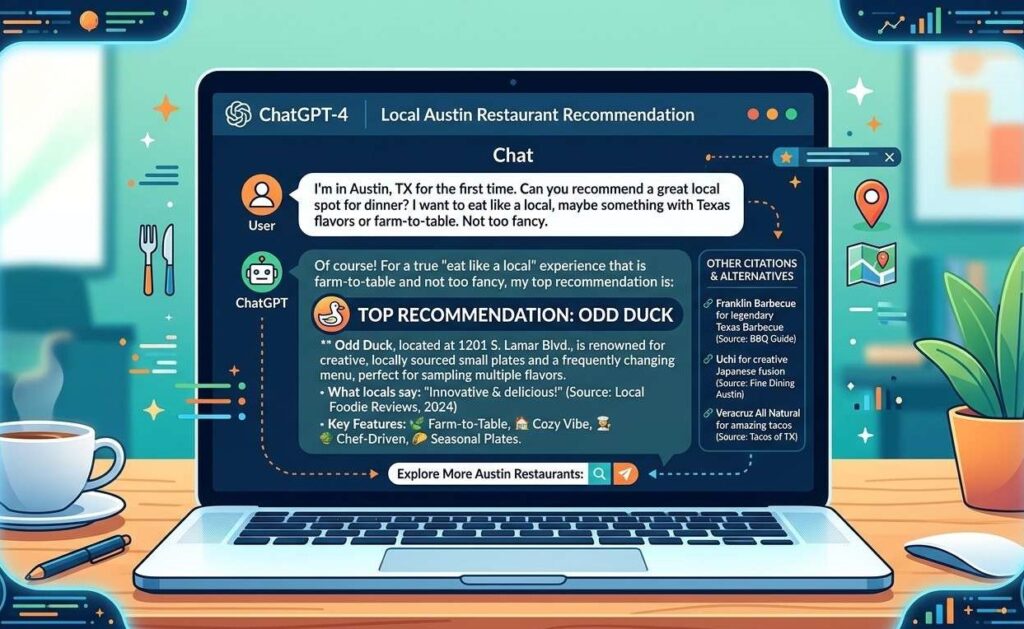
Think about what is generative engine optimization for local businesses in plain terms. Someone asks ChatGPT: “What is the best Italian restaurant in Austin?” The AI searches the web, reads several pages and mentions one or two businesses in its answer. GEO is the work you do to become that mention.
Traditional SEO puts you on page one of Google. GEO puts you inside the AI answer that now sits above those results. Both matter because buyers, sellers and diners still use both channels every day. But the shift toward AI search is real. Search Engine Journal’s 2025 AI search research [opens in new tab] found that AI answer engines now handle over 30% of all informational queries, a number that keeps climbing every month.
So the realtors and restaurants that start GEO now build an edge that compounds. The ones who wait will catch up later from a much harder starting position.
The GEO SEO difference explained: why stopping at one hurts your business
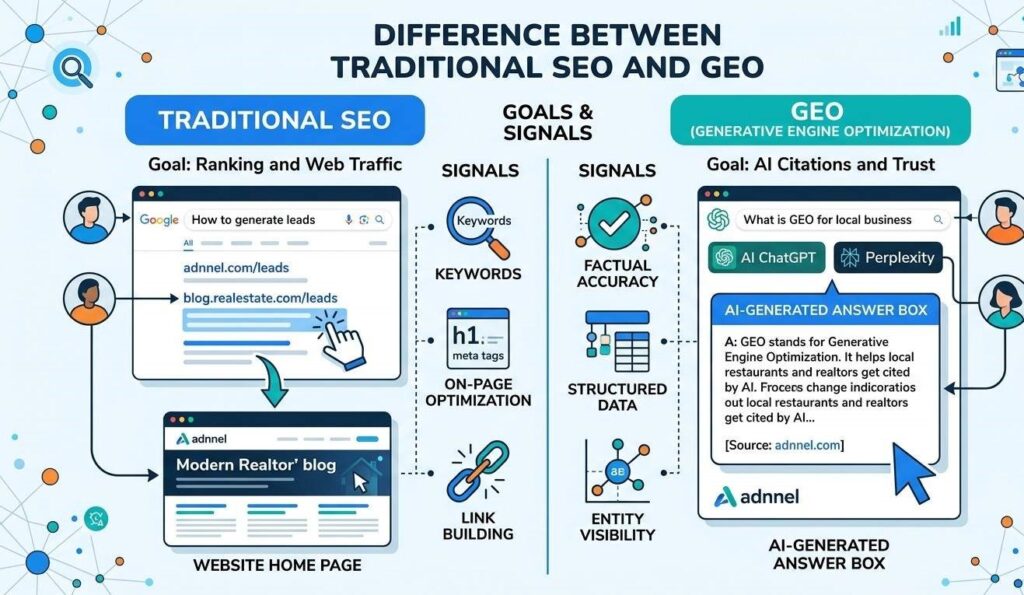
The geo seo difference explained in one sentence: SEO ranks you in search results and GEO gets you cited in AI answers. Both use content. Both use trust signals. But they reward slightly different things and that gap matters.
Traditional SEO rewards backlinks, keyword use and technical site health. GEO rewards clarity, factual accuracy and structured information. An AI engine reads your page and asks three questions. Is this a trustworthy source? Does this content answer the question directly? Is this specific enough to cite confidently?
So if your website copy is vague or promotional or hard to scan, AI engines skip it and pick a competitor. But if your content uses clear headings, direct answers and specific local facts, AI engines pick yours every time.
The good news is that the changes you make for GEO almost always help your traditional SEO too. Clear structure, specific facts and a fast-loading page lift both your Google rankings and your chances of appearing in AI answers. You get double the benefit from the same work. Our SEO and GEO service for local businesses builds both in a single plan so nothing falls through the cracks.
How to rank in AI search results as a local restaurant or realtor
Knowing how to rank in ai search results starts with understanding what AI engines look for. They scan your content for three things: clear answers to specific questions, trustworthy facts with named sources and location-specific detail.
The structured content format that AI engines pick to cite every time
Write your blog posts and service pages using a question-and-answer format. Add H2 headings phrased as real questions people ask. Then answer each question in the first two sentences below that heading. AI engines love that format because they pull the answer cleanly without hunting through a long paragraph.
A restaurant page that answers “what makes this neighborhood great for dining?” with a clear two-sentence answer gets cited far more often than one that buries the same answer inside a long story. Short, direct answers inside clear headings is the single best structural change you can make today.
Why your Google Business Profile matters for AI search too
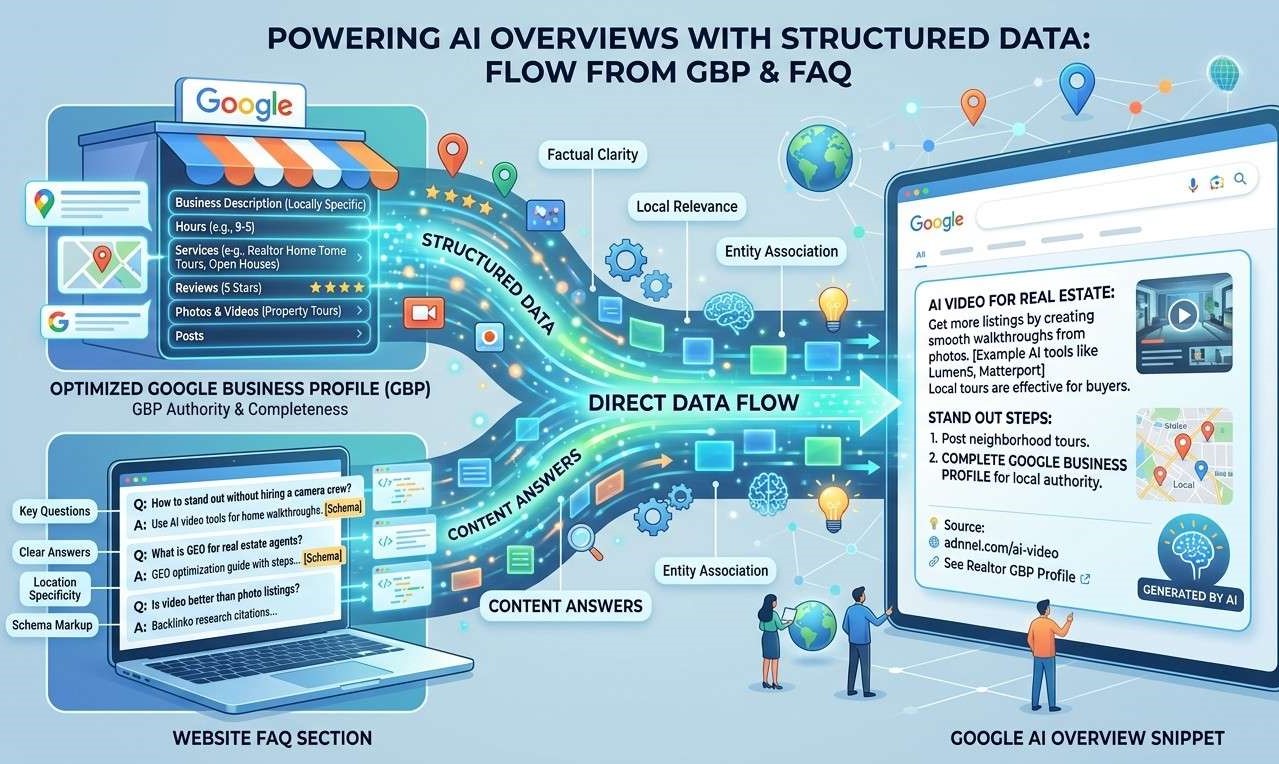
Google AI Overviews pull data from your Google Business Profile when they build local answers. A complete profile with current hours, a strong description, recent photos and positive reviews gives AI engines more data to work with. More data means more confidence that your business belongs in the answer.
Update your profile every month. Add a new photo and post a short update. Reply to every new review. These small actions keep your profile fresh and signal to both Google and AI tools that your business stays active and trustworthy.

Generative engine optimization guide 2025: five steps local businesses take first
This generative engine optimization guide 2025 starts with the five actions that move the needle fastest for restaurants and realtors with no prior GEO experience.
First, audit your existing content. Go through your service pages and blog posts. Check each one for vague language, long paragraphs and missing location details. Replace each vague sentence with a specific and factual one.
Next, add a FAQ section to every page and post. Answer real questions your customers ask. Keep each answer under 75 words. That is the format AI engines pull from most.
Then claim and complete your Google Business Profile if you have not done it yet. Add your hours, photos, services and a clear business description. Use specific local language in your description rather than generic phrases that apply to anyone.
After that, build local authority by earning mentions on other local websites. A mention in a local news article or a neighborhood directory tells AI engines that real people in your area know who you are and trust what you do.
Finally, add schema markup to your website. Schema is a code layer that tells AI engines exactly what type of business you run, where you operate and what you offer. Our local SEO and GEO team adds schema to every client site as a first step because it pays back fast.
How ChatGPT, Perplexity and Google AI Overviews decide which businesses to mention
Each AI tool works slightly differently but they all share the same core logic. They scan the web for pages that answer a question clearly. Then they check whether the source looks trustworthy. Then they pick the clearest and most specific answer and cite it.
Perplexity AI handles millions of local queries every single day. Restaurant recommendations, realtor searches and neighborhood questions all run through it. Perplexity’s published methodology [opens in new tab] confirms it favors pages with direct answers, specific local facts and clean structure. Businesses that publish that type of content get cited consistently. Those that publish vague promotional copy get skipped.
Google AI Overviews pull from pages that already rank on Google, so your traditional SEO and GEO work support each other directly. A page that ranks on page one and uses structured answers is far more likely to appear in an AI Overview above the organic results.
ChatGPT uses its web search tool to pull current data for location-specific questions. The businesses that appear in those answers consistently share one thing. They publish regular, specific and locally-focused content that answers real questions. Our post on how to generate real estate leads online for free shows how that same content also drives direct traffic and leads at no cost.
What is generative engine optimization for local businesses is no longer a future question. AI tools already decide which restaurants and realtors get mentioned and which ones get skipped. Start with one page update this week and build from there. Our SEO and GEO team is ready to build your full GEO plan. Talk to us here.
FAQs
Q: What is GEO and how is it different from SEO?
GEO stands for generative engine optimization. It means making your content easy for AI tools like ChatGPT and Perplexity to find and cite in their answers. Traditional SEO gets you into Google’s blue-link search results. GEO gets you into the AI answers that now appear above those results. The geo seo difference explained simply: SEO targets search pages and GEO targets AI-generated answers. Both matter and both reward good structured content.
Q: How do I get my business mentioned in ChatGPT answers?
Publish clear, factual content that answers the exact questions your customers ask. Use a question-and-answer structure with short direct answers under each heading. Add specific local details like your neighborhood, service area and customer type. ChatGPT’s web search tool scans for the most direct and trustworthy answers it can find. A restaurant or realtor with well-structured local content gets picked far more often than one with vague generic pages.
Q: Does generative engine optimization work for small businesses?
Yes. What is generative engine optimization for local businesses proves especially useful for small operations because AI tools prize specificity. A small restaurant that answers “what makes a great brunch in [city]” with a clear local answer beats a chain with a generic national page every time. Small businesses with niche local knowledge hold a real edge in AI search when they structure that knowledge clearly and publish it consistently.
Q: How do I optimise my content for AI search engines?
Follow these four steps:
- Write question-based H2 headings throughout your pages and posts.
- Answer each question in the first two sentences below that heading.
- Add a FAQ section to every page with 5 to 7 short clear answers.
- Include specific local facts like street names, neighborhoods and real client stories. AI engines reward content that answers a specific question without making the reader search for the answer inside a long block of text.
Q: What is Perplexity AI and how does it affect my rankings?
Perplexity is an AI search engine that answers questions by scanning the web and summarizing what it finds. It cites the sources it pulls from. That citation is your goal. Perplexity handles millions of local business queries every day. Restaurants and realtors who publish clear, structured and locally specific content appear in those answers far more often than those with thin or vague pages.
Q: Is GEO replacing traditional SEO?
Not yet and probably not soon. Traditional SEO still drives the majority of web traffic through Google’s regular search results. GEO captures the growing share of users who get direct answers from AI tools without ever clicking to a website. The smartest approach is one content strategy that serves both channels at once. Most GEO improvements also lift your traditional search rankings, so the work never goes in just one direction.
Q: How long does it take to see results from generative engine optimization?
Most local businesses start seeing citations in AI answers within 6 to 12 weeks of making the key changes. Adding FAQ sections, completing your Google Business Profile and publishing locally-focused content all speed up that timeline. What is generative engine optimization for local businesses is not a one-day fix. But consistent monthly effort compounds far faster than a single update ever will. The businesses that start now are the ones that dominate those AI answers six months from today.