Quick summary — You put money into Google Ads and nothing came of it. Or maybe you never tried because nobody explained how it works for a restaurant. Either way, you are not the problem. Most restaurant owners waste their budget on bad campaign setups. Others skip Google Ads entirely and hand those customers straight to a competitor down the street.
- Google Ads put your restaurant in front of people already searching for food near them.
- You can start with a daily budget as low as $10 to $15.
- Google Search Ads and Performance Max work best for most restaurants.
- Your ad copy, location targeting and landing page all affect how many people walk through your door.
- Most restaurants start seeing real results within two to four weeks of launch.
Why most restaurants burn through their Google Ads budget before seeing a single new table
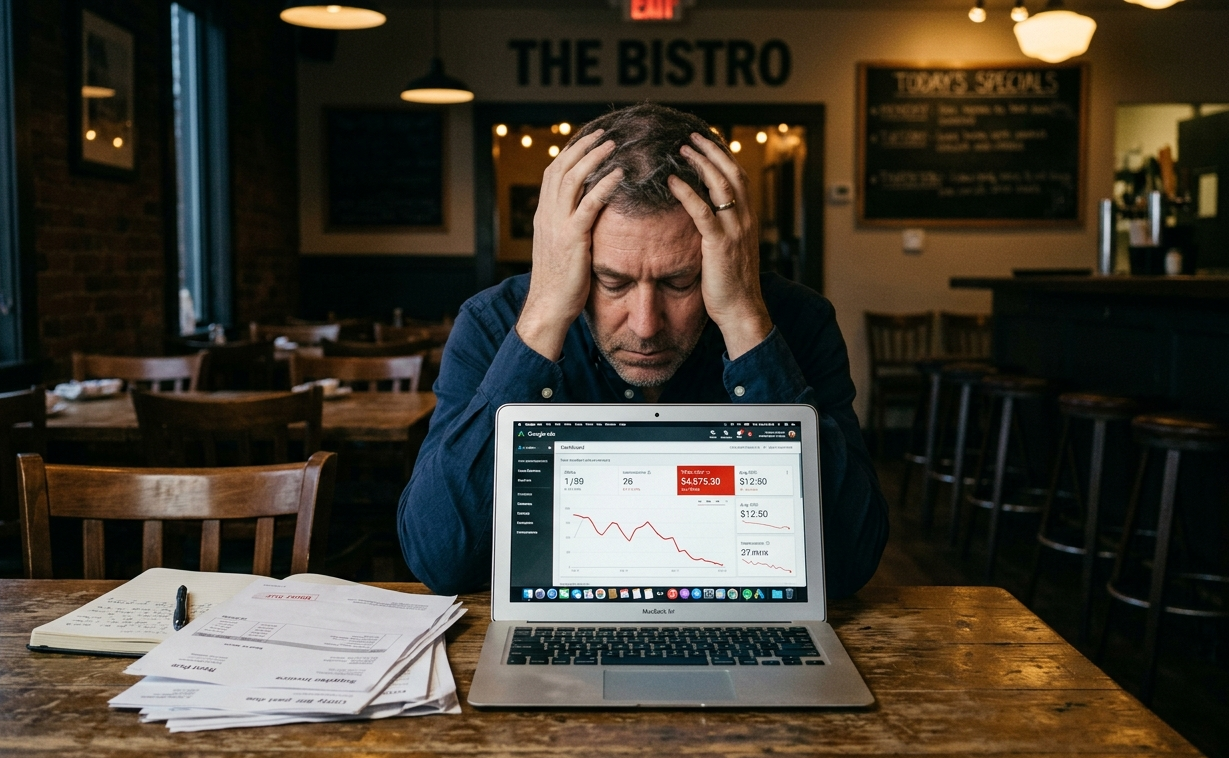
The problem is almost never Google Ads itself. The problem is the setup. Most restaurant owners pick a keyword like “food near me,” point the ad at their homepage and hope for the best. Google spends the budget fast. No new faces walk in.
Think about it. When someone types “best Thai food near downtown” into Google, they want to eat within the hour. That is your best possible lead. But if your ad targets a vague keyword and your landing page gives them no clear next step, you lose them in seconds.
The fix is simple. You need three things working together: tight location targeting, specific keywords and a page that tells people exactly what to do next. Miss any one of these and money leaves your account with nothing to show for it.
Also, a lot of restaurant owners pull the plug too early. Google’s algorithm needs time to learn your audience. Stopping after two or three days is like walking out of the kitchen before the lunch rush. Give any new campaign at least two full weeks before you draw any conclusions.
How to pick the right Google Ads campaign type for your restaurant
Not all Google Ads campaigns work the same way. Two types work especially well for restaurants: Search Ads and Performance Max. Each one does a different job.
Why Google Search Ads are the safest starting point
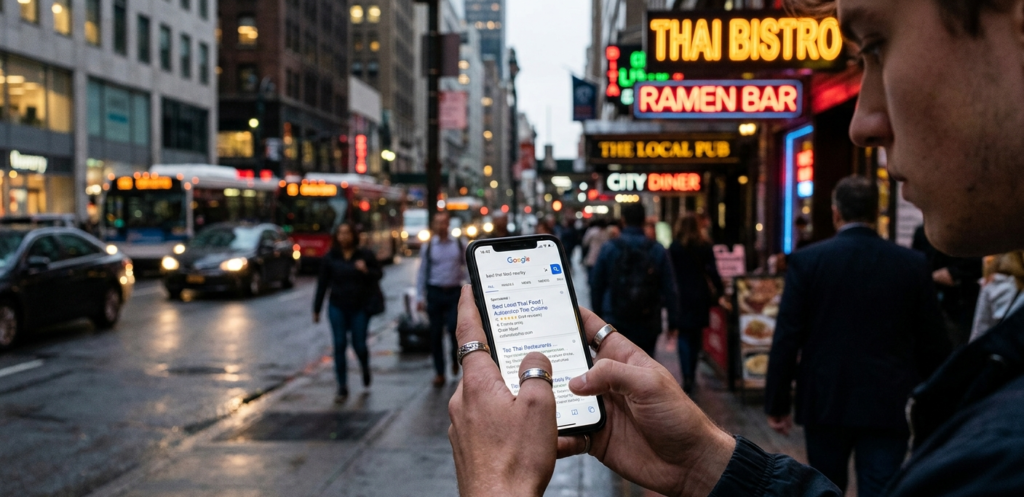
Search Ads appear at the top of Google results the moment someone types a query. Your ad shows before the organic listings, before the map pack and before competitors who are not paying. For a restaurant, this means you grab attention at the exact second someone decides where to eat.
Start with Search Ads if Google Ads is new to you. They give you full control over your keywords, your budget and your ad copy. You can see exactly which searches trigger your ads. Then you can turn off the ones that waste money.
How Performance Max campaigns reach more of your local customers at once
Performance Max runs your ads across Google Search, Maps, YouTube and Gmail from one single campaign. You give Google your photos, your address and a short description. Google then decides where to show your ad for the best return.
Performance Max works best once Google has some data from you. So the smart move is to run Search Ads first for two to three weeks. After that, layer Performance Max on top. That way Google already knows your audience and your campaign hits the ground running.
How to set a Google Ads budget that does not hurt your cash flow
You do not need a big budget to test Google Ads. A daily spend of $10 to $30 gives Google enough room to show your ads and gather data. Start on the lower end, watch what works and add budget only to the campaigns that bring people in.
One thing to know: Google can spend up to double your daily limit on a single high-demand day. So a $20 daily cap could result in $40 on a busy Saturday. Still, your monthly total will never go above your daily budget times the number of days in that month. Google’s budget help page [opens in new tab] explains this clearly.
Think about your cost per click. For restaurant keywords, the average click often costs between $1.50 and $4. That means a $15 daily budget can get you four to ten clicks per day. And if your landing page converts well, even four clicks a day can become real bookings.
Here is what that looks like in practice. A restaurant spending $300 per month on a focused local campaign can pull in 75 to 200 clicks. If 10% of those clicks lead to a booking, that is 7 to 20 new tables for $300. Your average spend per table will quickly tell you whether that math makes sense. You can also browse our marketing blog for more data-backed guides on restaurant digital strategy.
How to write restaurant ad copy that makes hungry people stop and click
Your headline is the most important part of your ad. You get three headlines and two descriptions. Use them all. The first headline should include your main keyword. Your second should name a benefit. And the third should create urgency or say what makes you different.
So here is the deal. A headline like “Best Pasta in [Your City]” will outperform “Italian Restaurant” every single time. People scan fast. They click the result that matches exactly what they already want. Name a dish, name a neighborhood, name the vibe.
Your description lines build trust. Use them to share a detail that answers a real question: “Family-run since 2009,” “Open until midnight on weekends” or “Book a table in under 60 seconds.” Small details like these push hesitant people into action.
Also, always match your ad copy to your landing page. If your ad says “Best Tacos in Miami,” your landing page needs to say the same thing. If it drops them on a generic homepage instead, people leave. Google also notices this mismatch and lowers your Quality Score, which pushes up your cost per click. That means worse results for the same spend.
How to target local customers with Google Ads so you only pay for nearby clicks
Location targeting is the most important setting in your whole campaign. Get it wrong and you pay for clicks from people who will never travel to your restaurant.
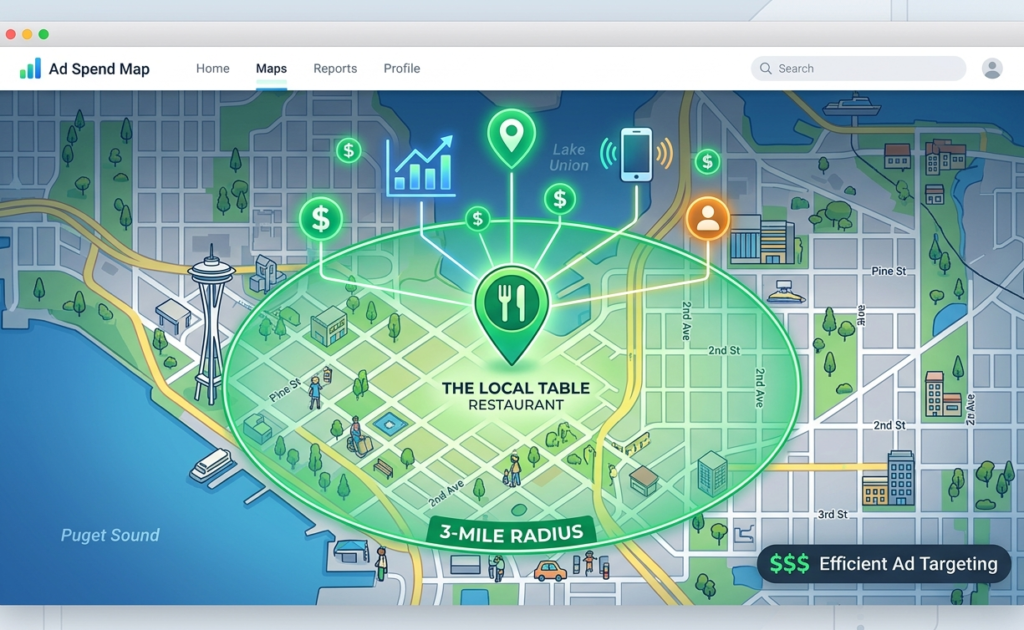
Set your target radius based on how far your customers realistically travel to eat with you. A fast-casual lunch spot might target a two-mile radius. A fine dining restaurant might push to ten or fifteen miles. You can also target specific zip codes or neighborhoods. This works well if you know where most of your regulars already come from.
On top of radius targeting, add location extensions to your ads. These display your address, phone number and a map pin right inside the ad. Think with Google [opens in new tab] found that 76% of people who search for something nearby visit a business within one day. A location extension removes every barrier between that search and your front door.
Also use ad scheduling. If your restaurant closes on Mondays, switch your ads off on Mondays. If your dinner rush peaks at 5 PM, boost your bids between 4 PM and 7 PM. These adjustments make every dollar in your budget work harder.
How to read your Google Ads numbers and know if your campaign is actually working
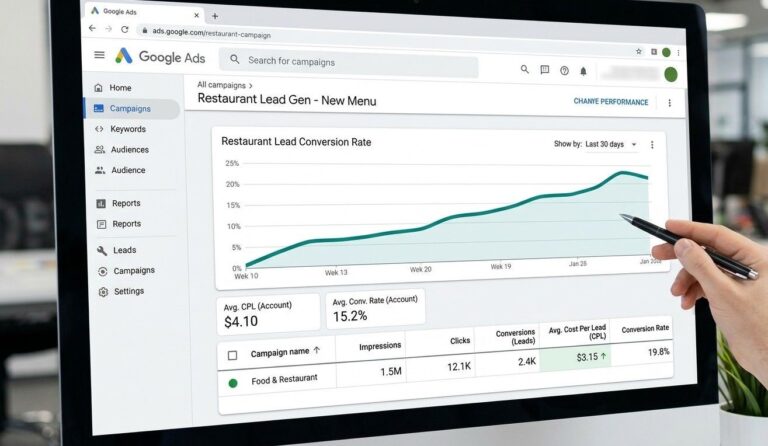
Most people open Google Ads, see a wall of numbers and close the tab. You really only need to track five things. Start with impressions, clicks, click-through rate, cost per click and conversions.
Impressions show how many people saw your ad. Clicks show how many of them acted on it. Your click-through rate, or CTR, is your clicks divided by your impressions. For restaurant ads, a CTR between 3% and 8% is a solid target. Backlinko’s Google Ads benchmark data [opens in new tab] shows the average CTR across all industries sits around 2%. So restaurants that hit 5% are doing very well.
Conversions matter most of all. A conversion is any action you tell Google to track. This could be a phone call, a click on your reservation link or a form submission. Set up conversion tracking before you launch. Without it, you are flying blind on every decision you make.
If your CTR is low, the problem is probably your headline or your keyword choice. But if your CTR is high and conversions are still low, the problem lives on your landing page. Fix one thing at a time so you know exactly what changed the result. Pick one thing from this post and do it today. Set up one Search Ad campaign with a tight local radius and write a headline that names a specific dish. That single step puts you ahead of every restaurant in your area still relying on foot traffic alone. And if you want a team to run the whole thing, book a free call with us and we will get you started
Frequently Asked Questions
Q: Do Google Ads work for restaurants?
Yes, they do. Google Ads put your restaurant in front of people already searching for a place to eat near them. That search intent is what makes them effective. A well-set-up campaign with specific keywords, location targeting and good ad copy can bring in new customers every week. Our restaurant marketing service builds this as part of a full strategy.
Q: How much should a restaurant spend on Google Ads?
A good starting point is $10 to $30 per day. That works out to $300 to $900 per month. Start small, see which campaigns bring people in and then increase spend on the ones that convert. Do not put more money behind a campaign until you know the setup actually works.
Q: What type of Google Ads works best for restaurants?
- Google Search Ads work best for catching people already searching for food near them.
- Performance Max spreads your ads across Google Maps, YouTube and Gmail from one campaign.
- Start with Search Ads and add Performance Max after two to three weeks of data.
Q: How do I target local customers with Google Ads?
Use radius targeting centered on your restaurant address. Pick a radius that matches how far your typical customer travels. Add location extensions so your address shows inside the ad. Also set an ad schedule so your ads only run during your open hours or your busiest periods.
Q: What is a good click-through rate for restaurant ads?
A CTR between 3% and 8% is a strong result for restaurant Google Ads. The average across all industries is around 2%. So anything above 4% puts you ahead of most advertisers. If your CTR is under 2%, test a headline that names a specific dish or a neighborhood your customers already recognize.
Q: How long before Google Ads show results?
Most restaurants start to see meaningful data within two weeks of launch. The first week is mostly Google learning which searches match your ads. By week two you will see which keywords drive clicks and which drain your budget. Give any new campaign at least 30 days before you make big changes.
Q: Can a small restaurant afford Google Ads?
Yes. You can start with $10 a day and pause or stop any time you want. There is no minimum spend and no long-term contract with Google. The key is tight targeting and specific keywords. A focused $300 budget beats a $1,000 budget spread thin across a whole city. Our Google Ads management service helps small restaurants get results without wasting spend.