Quick answer — Pinterest marketing for real estate agents works because the platform reaches 40% of US households earning over $150K annually, exactly the income bracket most active in property transactions. Set up a Pinterest business account, create boards around your market area and listing types, optimise each pin description with location keywords and link every pin back to your website or listing page.
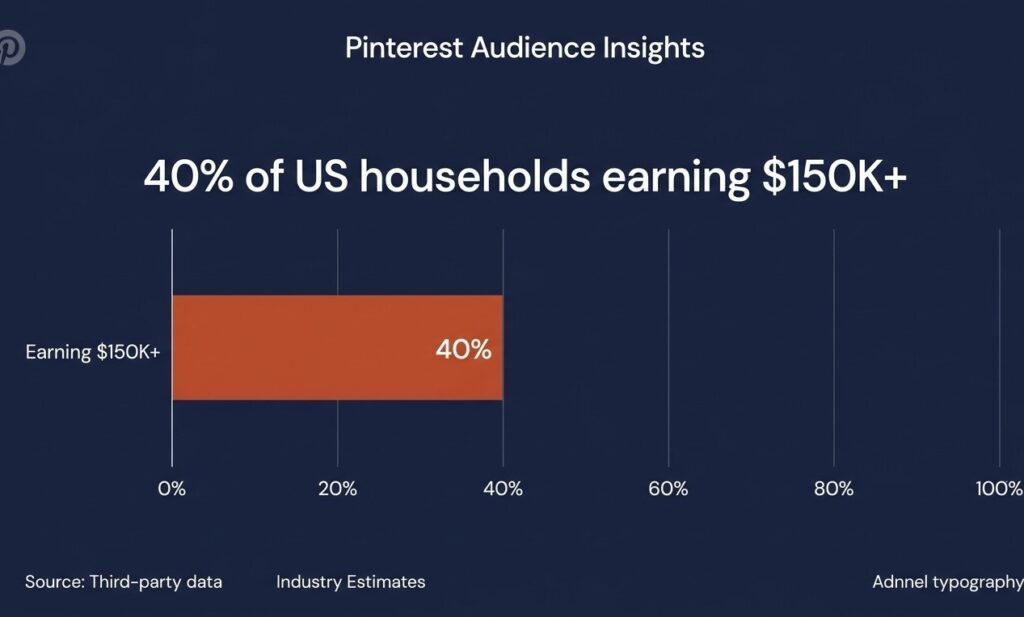
Most real estate agents ignore Pinterest entirely. That is a mistake worth examining. According to Sprout Social’s 2026 marketing statistics, Pinterest reaches around 40% of US households earning over $150,000 a year. That income bracket buys homes. Pinterest marketing for real estate agents taps into an audience that is actively planning their next major life decision, including where to live, on a platform almost no competing agent is using.
- Pinterest marketing for real estate agents works because the platform’s users are high-income, planning-oriented and actively saving content for future decisions.
- Set up a Pinterest business account to access analytics, outbound click data and the ability to add a website link to every pin.
- Pinterest boards for realtors should cover your specific neighbourhoods, buyer guides, home staging and local lifestyle content.
- Pinterest SEO for real estate means writing pin descriptions with location-specific keywords, not generic captions.
- Every pin should link to a page on your website, because Pinterest consistently drives outbound traffic at higher rates than most social platforms.

Why Pinterest Marketing for Real Estate Agents Actually Works
Pinterest is not a social network in the traditional sense. It is a visual search engine where users come with intent. They are planning a home renovation, researching neighbourhoods, saving ideas for their future house. That planning mindset is exactly where a real estate agent wants to appear.
The demographic match is unusually strong. According to Sprout Social’s 2026 social media marketing statistics, Pinterest reaches around 40% of US households earning over $150,000 annually. For context, the median US household income is around $80,000. The Pinterest audience skews significantly toward the income level that actively transacts in property.
The other factor working in your favour is low competition. Most real estate agents focus on Instagram, Facebook and short-form video (if you use video content, see our TikTok marketing strategy for local businesses). Almost none have a serious Pinterest strategy. That means the first agent in your market to build a well-optimised Pinterest presence has almost no competition for search terms like “homes for sale in [your city]” or “open plan kitchen house [neighbourhood name]”.
Pinterest sits alongside SEO as a long-term discovery channel. For a full picture of how the two complement each other, our SEO guide for real estate agents covers how to build search visibility on Google while Pinterest handles the visual discovery layer.
How to Set Up a Pinterest Business Account for Real Estate
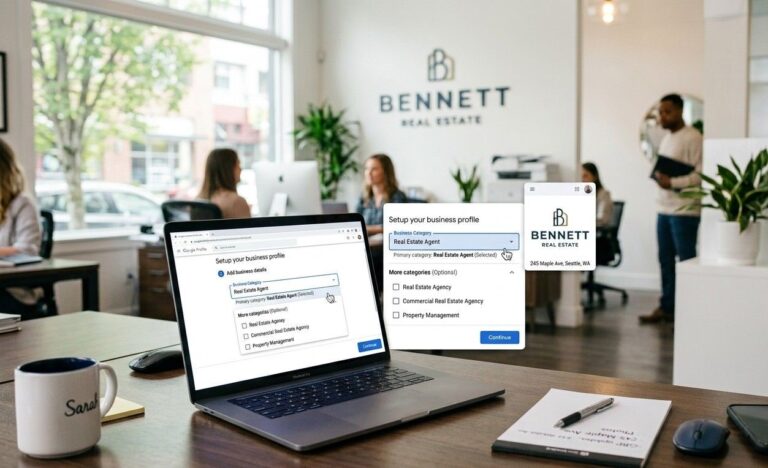
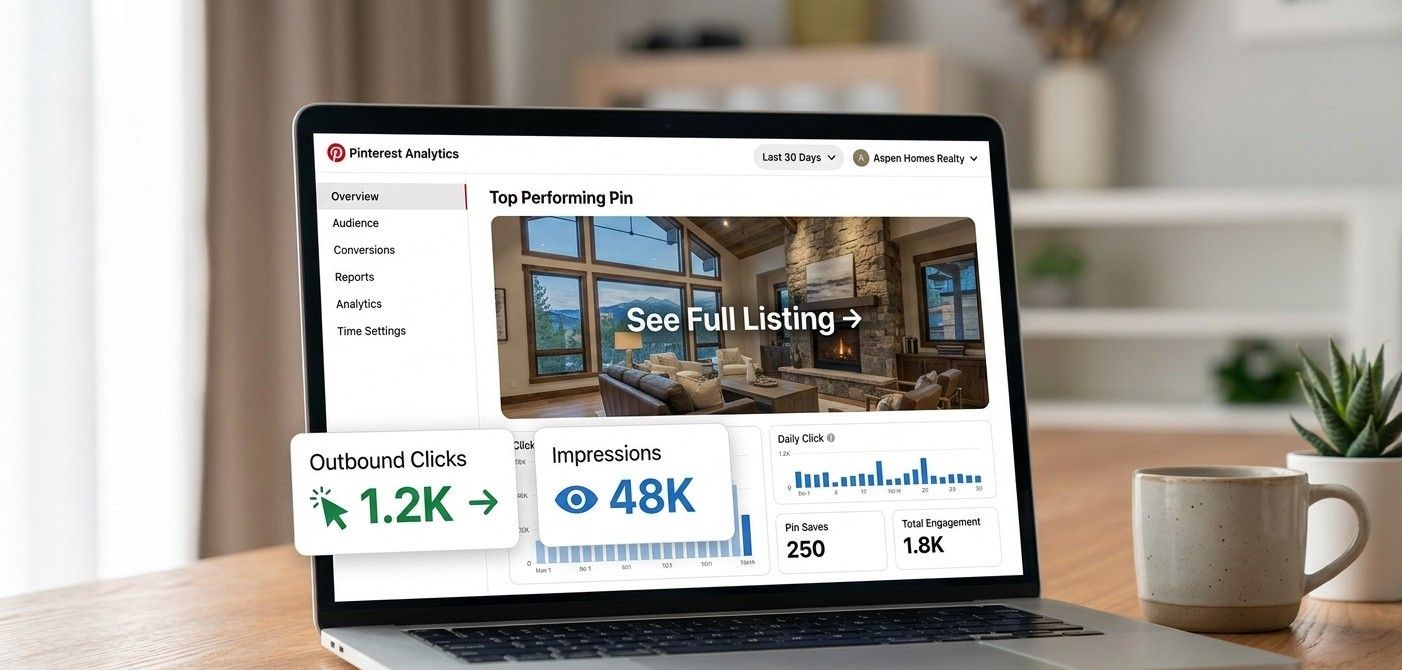
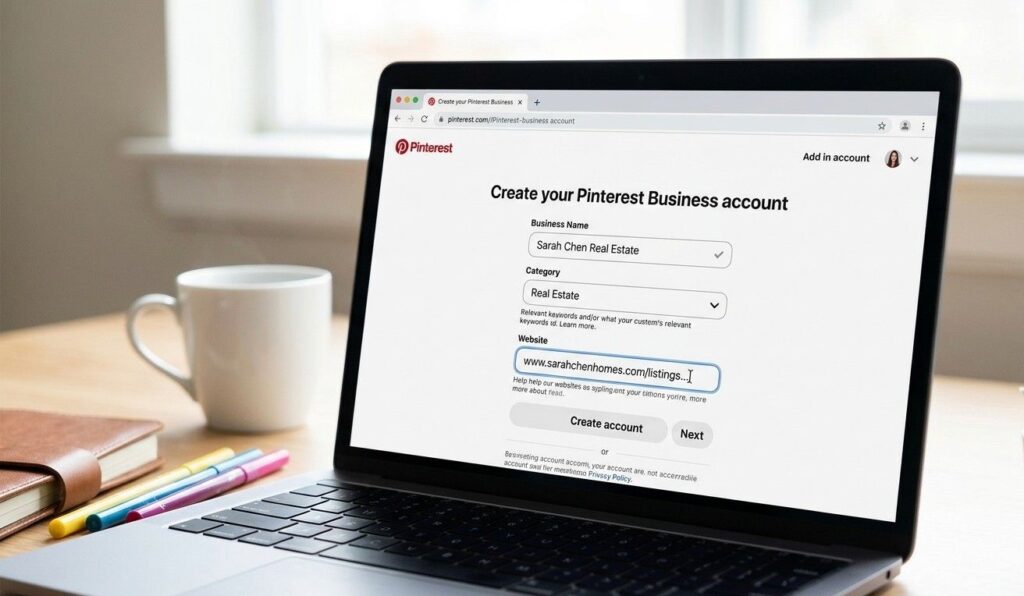
A personal Pinterest account will not work for real estate marketing. You need a business account, which is free and takes about ten minutes to set up at business.pinterest.com. The business account unlocks Pinterest Analytics, the ability to add a website link to your profile and access to promoted pins if you later decide to run paid campaigns.
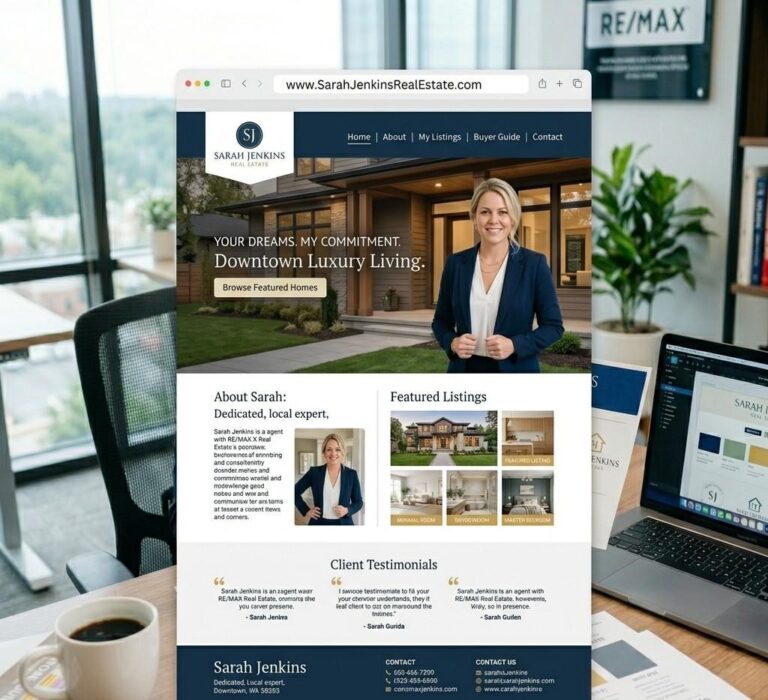
When filling in your profile, use your real name and the word “Realtor” or “Real Estate Agent” plus your city. Something like “Sarah Chen, Atlanta Real Estate Agent” gives Pinterest’s search algorithm the context it needs to surface your profile for location-based queries. Add your website URL to the profile. Then claim your website in the settings panel. This is a short verification step, but it is required before Pinterest attributes outbound clicks to your account in analytics.
Write your profile bio in one to two sentences. Lead with your location and speciality: “Helping buyers and sellers in [City] navigate one of the most important decisions of their lives. Covering [Neighbourhood 1], [Neighbourhood 2] and [Neighbourhood 3].” Include the names of your core neighbourhoods because Pinterest indexes profile bios for search.
Finally, upload a profile photo of yourself, not a logo. Pinterest is a personal discovery platform. Profiles with a human face get followed at a higher rate than brand logos—a core principle of strong personal branding for real estate agents who want to stand out in competitive local markets.
How Many Pinterest Boards for Realtors and What to Name Them
Start with six boards. Six is enough to cover your core content categories without spreading your early posting effort too thin. You can add more boards as your account grows.
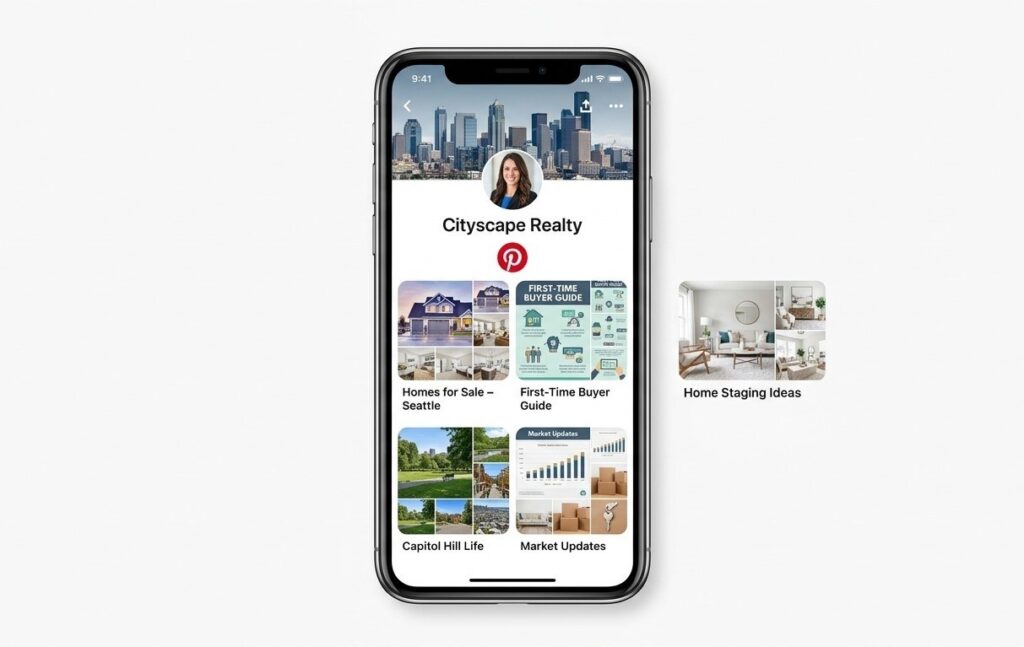
The six board categories that consistently perform for real estate agents are: your active listings or recently sold properties, a buyer’s guide for your specific market, a neighbourhood guide for each of your top one or two areas, home staging and design inspiration, local lifestyle content (restaurants, parks, schools, events) and a tips board covering questions buyers and sellers ask you most.
Name your Pinterest boards for realtors with keywords, not clever titles. “Homes for Sale in Austin TX” outperforms “My Listings” for search visibility. “First-Time Buyer Tips for Atlanta” outperforms “Buyer Resources”. Pinterest indexes board names directly, so the words in the title become the keywords you rank for.
Write a board description for every board. At least two sentences. Include the location name and the primary topic. Board descriptions do not show on the public profile but Pinterest’s algorithm reads them for context. A well-written description increases the chance your board appears in search results for relevant queries.
How Pinterest Drives Real Estate Traffic Back to Your Website
Every pin you save has a destination URL field. This is the mechanism that makes Pinterest real estate traffic valuable. Unlike Instagram, where the only link is in your bio, every single Pinterest pin can link directly to a specific page on your website. A pin of a listing links to that listing page. A pin of a neighbourhood guide links to that blog post. A pin of a first-time buyer checklist links to your lead capture page.
That link structure makes Pinterest one of the highest outbound click rates of any social platform for content-forward businesses. According to Sprout Social’s 2026 statistics, 85% of weekly Pinterest users have made a purchase based on a pin they saw. The intent-to-action ratio on Pinterest is higher than almost any other discovery platform because users arrive in a planning mindset, not a passive scrolling one.
For real estate specifically, the content types that drive the most outbound clicks are neighbourhood lifestyle pins linking to your area guides, home listing pins with a strong “See Full Listing” call to action text overlay and educational infographic pins linking to your buyer or seller guide pages. Create vertical images at a 2:3 ratio (1000×1500 pixels is Pinterest’s recommended size). Vertical pins take up more feed space and earn more impressions for the same posting effort.
Our lead generation service for real estate agents includes building the landing pages that your Pinterest traffic links to, so the click becomes a contact rather than a bounce.
Pinterest SEO for Real Estate: How to Get Found in Search
Pinterest SEO for real estate means treating your pin descriptions the same way you would treat page meta descriptions for Google. Pinterest is a search engine. Users type queries. Your content either matches those queries or it does not.
Write a two to three sentence description for every pin. The first sentence should include your primary keyword naturally: the neighbourhood name, the property type and the city. “This 3-bedroom ranch-style home in East Nashville sold in 5 days — here is what made it stand out.” The second sentence adds detail. The third adds a soft call to action: “See the full property breakdown on the blog.”
Use keyword-rich alt text when uploading pin images. Pinterest reads image alt text for its algorithm. Add your location and content topic as the alt text, not just a generic description of the photo.
Also create idea pins (Pinterest’s multi-frame story format) around frequently searched real estate topics. Titles like “5 Questions to Ask at a Home Viewing” or “What Your Credit Score Needs to Be to Buy in 2026” match the conversational search queries real buyers type. Idea pins rank well in Pinterest’s home feed and search results, and they drive follows more effectively than standard single-image pins.
What Real Estate Content Performs Best on Pinterest in 2026
Neighbourhood guide pins consistently outperform listing-only content on Pinterest. A pin titled “Living in [Neighbourhood]: Schools, Commute Times and Local Eats” earns saves from buyers who are actively researching that area. Each save extends the pin’s reach without any additional effort on your part. Saves on Pinterest function like shares on other platforms.
Infographic-style pins also perform strongly. A vertical graphic titled “10 Things to Check at a Home Viewing” or “The Home Buying Process in [State]: 9 Steps” gets saved repeatedly by users who want to reference it later. Each save brings the pin back into active feeds. For this type of content, create the infographic in Canva using a 1000×1500 pixel template, export it as a PNG and upload directly to Pinterest with a keyword-rich description.
Market update pins are underused but effective. A monthly pin titled “[City] Real Estate Market: [Month] 2026” targets buyers and sellers who are actively monitoring the market. Pair it with a short summary of median prices, days on market and inventory levels. Link it to your website’s market update page. This type of content builds your authority as a local expert and attracts the serious buyers and sellers who are closest to making a decision.
For the full social media strategy across all platforms, our social media management service for real estate agents builds monthly content calendars that include Pinterest alongside Instagram and Facebook so your content works across every channel.
Start Building Your Pinterest Presence This Week
Pinterest marketing for real estate agents is one of the lowest-competition, highest-intent channels available right now. Set up a business account, build your six starter boards and publish five pins this week. When you want a full social media strategy built around your market area, our real estate marketing team at Adnnel handles content creation and platform management across every channel. Book a free call today.
Frequently asked questions
Is Pinterest worth it for real estate agents?
Yes, especially for agents targeting move-up buyers and luxury clients. According to Sprout Social’s 2026 marketing statistics, Pinterest reaches around 40% of US households earning over $150,000 annually. Pinterest marketing for real estate agents also faces almost no competition from other agents, which means early movers in most markets can rank for location-based searches without the saturation they face on Instagram or Facebook. The effort-to-visibility ratio is favourable.
What type of real estate content performs best on Pinterest?
Neighbourhood guide pins, home buying and selling infographics and market update pins consistently earn the most saves and outbound clicks. Pinterest users come to the platform with a planning mindset, so practical, specific content outperforms general listing promotion. A pin titled “What to Look for at a Home Viewing in 2026” earns saves from active buyers long after you publish it. Pinterest marketing for real estate agents works best when content answers real questions buyers are searching.
How do I set up a Pinterest business account for real estate?
Go to business.pinterest.com and create a free business account. Use your name plus your city and role in the profile name, for example “James Lee, Dallas Realtor”. Add your website URL, claim your website in the settings to unlock outbound click tracking, and write a bio that names the neighbourhoods you cover. This setup takes about ten minutes and unlocks Pinterest Analytics, which shows you exactly which pins drive traffic back to your website.
How many Pinterest boards should a realtor have?
Start with six Pinterest boards for realtors: active or recent listings, a buyer’s guide for your market, neighbourhood guides for your top one or two areas, home staging inspiration, local lifestyle content and a tips or FAQ board. Name each board with location-specific keywords rather than general titles, because Pinterest indexes board names for search. Add more boards as your account grows beyond 50 to 100 published pins and you have a clear sense of which topics your audience saves most.
Can Pinterest drive traffic to a real estate website?
Yes. Every Pinterest pin has a destination URL field, which means each pin links directly to a specific page on your website. That structure gives Pinterest a higher outbound click rate than most social platforms. For real estate, the highest-traffic pins are neighbourhood guide posts, listing pages with a clear call to action overlay and educational content like buyer checklists. Pinterest real estate traffic compounds over time because pins continue to surface in search results months after you publish them.
How do I use Pinterest SEO for real estate listings?
Write a two to three sentence description for every pin that includes the neighbourhood name, property type and city. Use keyword-rich board names like “Homes for Sale in [City]” rather than generic titles. Add descriptive alt text to every uploaded image. Also target conversational search queries with idea pins: titles like “How to Buy a Home in [City] in 2026” match what buyers type into Pinterest’s search bar. Pinterest SEO for real estate rewards consistency, so publish at least three to five new pins per week.