Quick answer — Restaurant lead generation is the process of attracting new diners through digital channels like Google Ads, email marketing and retargeting, so your tables fill without relying on discounts. The most effective restaurant lead generation strategies combine a Google Business Profile optimised for local search, a segmented email list and paid retargeting ads that bring back website visitors who did not book. Restaurants that treat marketing as a system rather than a one-off promotion consistently outperform those that default to discount deals.
Your tables sat half-empty on Wednesday night, so you offered a 20% discount to fill them. The discount worked, but your margins took a hit and every new customer expects the deal again next time. Restaurant lead generation strategies solve this problem for good: they bring in guests who want to dine with you at full price, not just when you’re giving things away.
- Restaurant lead generation strategies build a steady flow of new diners without training your audience to wait for a deal.
- A Google Business Profile with weekly posts and updated photos generates free local leads every single day.
- According to HubSpot’s 2024 State of Marketing Report, email marketing returns $36 for every dollar spent, proving its high-ROI potential across industries—whether applied to hospitality or adapted for high-ticket service niches like email marketing for real estate agents.
- Retargeting ads re-engage people who visited your website but did not book, often at a cost per lead below $30.
- Collecting guest emails at the point of reservation or Wi-Fi login gives you a direct channel that no algorithm can cut off.
What Is Lead Generation for Restaurants?
Most restaurant owners think of marketing as promotion: post on Instagram, run a special, hope for a busy Friday. Lead generation is something more deliberate. It is the process of identifying people who are likely to become paying guests and then pulling them into a system that moves them from curious to booked.
In practice, a restaurant lead is anyone who gives you a way to follow up. That could be an email address captured through your Wi-Fi login page, a phone number from an online reservation, or a click on a Google Ad that sends someone to your booking form. Each of those actions is a lead because you now have permission and a channel to close the sale.
The reason this distinction matters is cost. Running a discount to fill tables is a short-term fix with a long-term problem: it attracts deal-seekers, not loyal regulars. A proper restaurant lead generation system attracts people who are already looking for what you serve, captures their contact details and then converts them through a sequence of touchpoints. The result is a full dining room at your actual menu price.
Every restaurant lead generation strategy starts with one question: where are your future guests looking for a place to eat right now? The honest answer in 2026 is Google.
Your Google Business Profile Is Your Best Free Lead Source
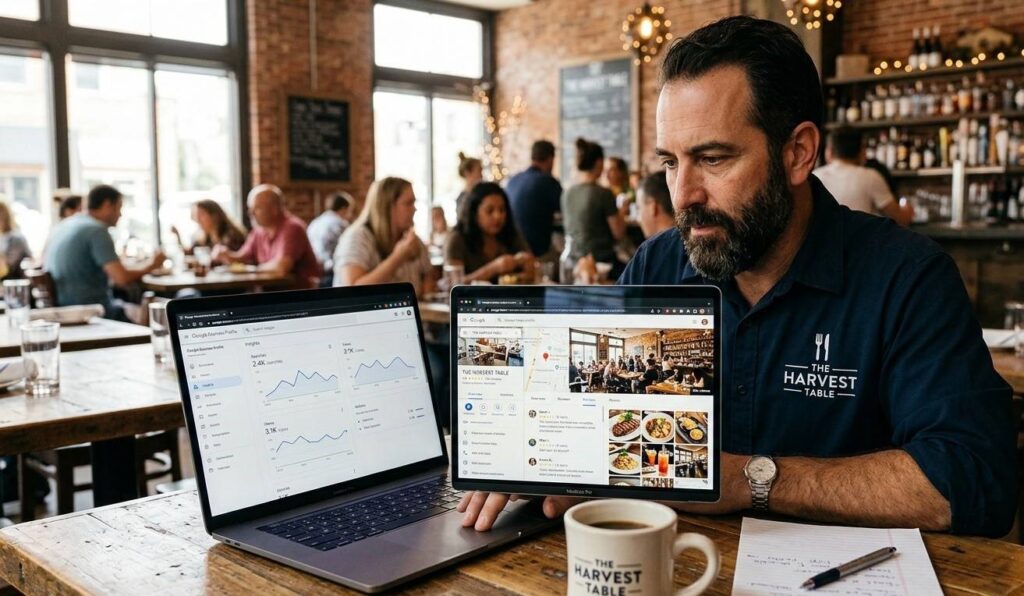
Before you spend a single dollar on paid ads, your Google Business Profile (GBP) should be generating leads for free. When someone searches for a place to eat near your location, the local map pack is the first thing they see. Your GBP listing is what determines whether you appear there.
A half-completed profile is a wasted opportunity. Add every photo category Google offers: interior, exterior, team, food. Upload new photos at least twice a week because Google’s algorithm treats fresh uploads as a signal of an active, relevant business. Add your menu directly inside the GBP dashboard rather than linking to a PDF. Google can read the text inside a linked menu and use it to match your listing to relevant searches like ‘vegetarian pasta near me’ or ‘seafood birthday dinner downtown.’
Post to your GBP weekly. These posts sit on your listing for seven days and appear in search results. A post about your weekend special, a new menu item or an upcoming event gives searchers a reason to click through and book. Restaurants that keep their GBP active with fresh posts and recent photos consistently outrank competitors whose listings sit untouched.
Finally, turn on the messaging feature and respond to reviews within 24 hours. Both actions signal responsiveness to Google and to prospective guests. A listing with 40 fresh reviews and active posts outperforms one with 200 old reviews and no activity almost every time.
How to Build a Restaurant Email List That Actually Fills Tables
An email list is the only marketing asset you fully own. Your Instagram following can vanish if the algorithm changes. Your email list stays yours no matter what.
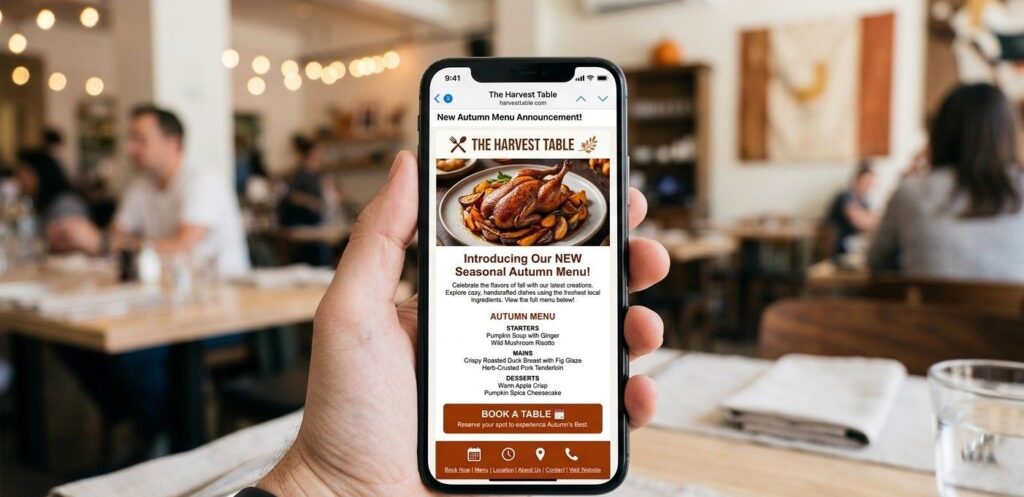
The fastest way to build yours is to collect emails at every point of contact. On your reservation page, add an optional checkbox: ‘Send me exclusive specials and new menu updates.’ Most reservation platforms like OpenTable, Resy and Tock let you capture this data natively. For walk-ins and counter service, a Wi-Fi login page that asks for an email in exchange for access works well. A tablet at the host stand with a simple sign-up form is another option that consistently converts in higher-traffic environments.
Once you have 200 or more subscribers, segment your list by visit frequency. Guests who dine once a week get a different message than first-timers who have not been back in 90 days. A win-back email for lapsed guests—especially when paired with strategies on how to create a restaurant loyalty programme using digital marketing—performs far better than a generic newsletter.
According to HubSpot’s 2024 State of Marketing Report, email marketing returns $36 for every dollar spent for B2C brands, making it the highest-ROI channel in the study. For a restaurant sending two emails per month at a cost of roughly $30, that return is hard to ignore.
How Google Ads Generate Restaurant Lead Generation Results Fast
While foundational SEO for restaurant websites takes months to fully compound, Google Ads can put your restaurant in front of high-intent searchers today. The key is knowing which campaign type to run and what to bid on.
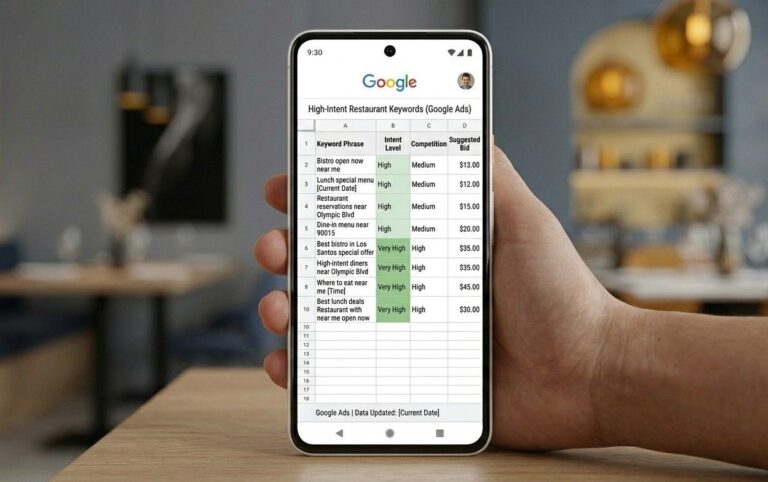
Start with Search campaigns targeting keywords with clear booking intent: ‘Italian restaurant open now [city]’, ‘best brunch near [neighbourhood]’, ‘private dining room [city].’ These searches happen when someone is already in decision mode. Your ad appears at the top of the results page with a direct link to your reservation form or a call button. One click, one conversion opportunity.
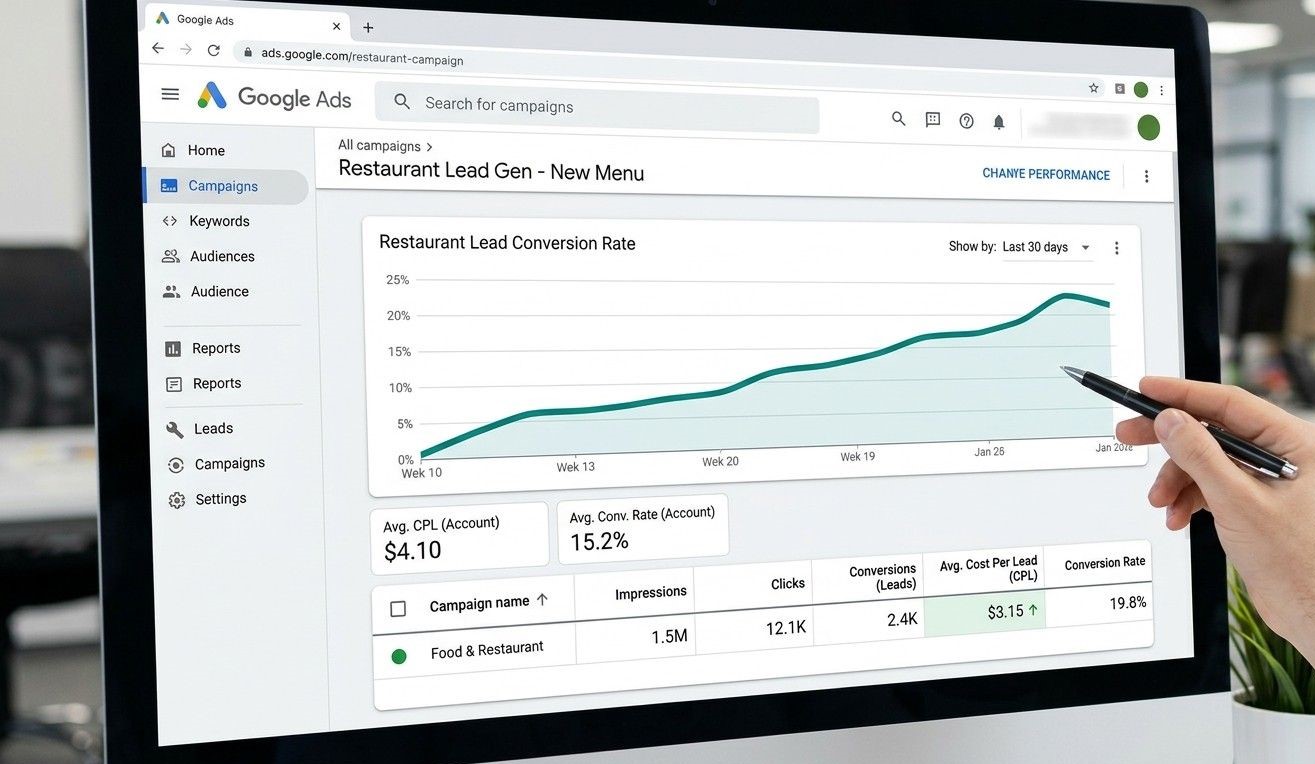
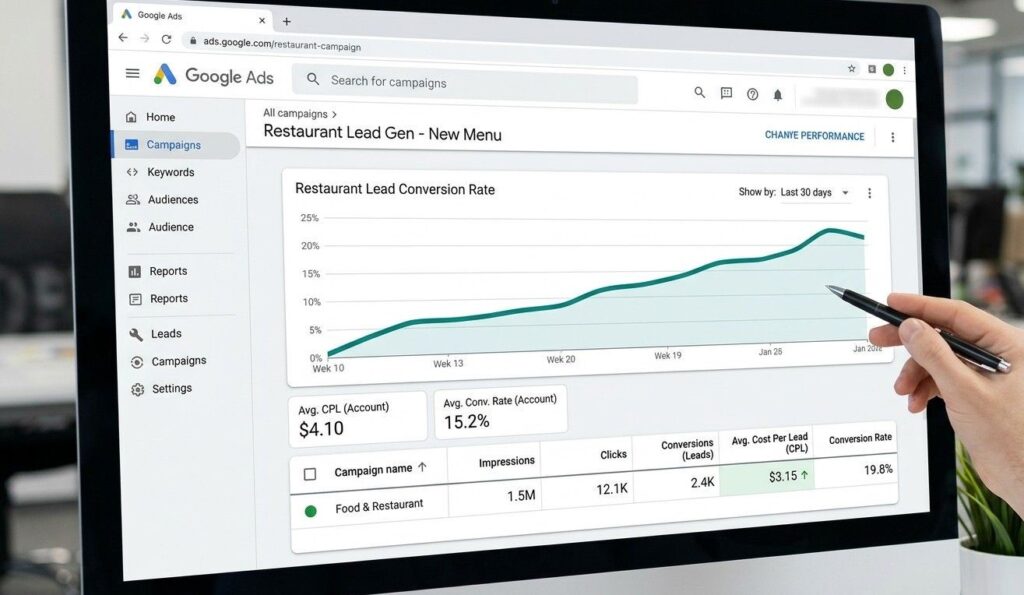
The numbers here are encouraging. According to WordStream’s 2024 Google Ads Benchmarks, the restaurant and food industry saw a 72% increase in Google Ads conversion rates in 2024, with an average cost per lead of just $29.67. That is one of the lowest CPLs across all industries tracked in the study.
To get the most from your budget, link your Google Ads account to your Google Business Profile. This activates location extensions, which show your address, phone number and a direct link to get directions right inside the ad. Location extensions typically increase click-through rates by 10 to 15% and require no extra budget.
Performance Max campaigns are worth testing once your Search campaign is running. They automatically place your ads across Google Search, Maps, YouTube and Display, optimising toward conversions. For restaurants, Performance Max often outperforms manual Search campaigns after about four weeks of data collection.
Retargeting: The Fastest Way to Get New Restaurant Customers Back
Most people who visit your website do not book on their first visit. Retargeting lets you follow up with those visitors as they browse other sites, use apps or scroll social media.
Here is how it works in practice. A visitor lands on your website from a Google search. They look at your menu and your ‘Book a Table’ page but leave without booking. A retargeting pixel on your site adds them to a custom audience. Over the next five days, they see your ads on Facebook, Instagram and across the Google Display Network. The ads show your signature dish, your dining room or a short video of your kitchen in action. The call to action is a direct link back to your reservation page.
The data supports this approach for restaurant lead generation. Google Analytics shows that most restaurant websites convert between 1% and 3% of first-time visitors. Retargeting campaigns recover a meaningful share of the other 97% at a fraction of the cost of acquiring a cold audience. The average cost per click for retargeting on Google Display sits below $1.25 based on 2025 industry data, which makes this one of the most cost-efficient channels in your marketing stack.
Segment your retargeting audiences by page visited. Someone who viewed your private dining page is a much warmer lead for a group booking campaign than someone who only viewed your home page. Treat them differently and your conversion rate will reflect that.
Do Restaurant Lead Generation Strategies Work Better Than Discounts?
The real cost of a discount
A 20% discount sounds like a small concession to fill tables. In reality, it often wipes out your profit margin entirely. If your food cost is 30% and your labour cost is 35%, you are already at 65% before rent, utilities and marketing. A 20% discount on a $50 cover brings in $40. That cover now costs you money rather than making it.
What a lead generation system delivers instead
A restaurant lead generation system builds a list of people who want to dine with you at your actual price. When you run an email campaign to that list, you are not discounting. You are giving your best guests early access to a new menu, a seasonal event or a chef’s table experience. These offers carry perceived value without reducing your margin.
The other advantage is predictability. A discount campaign creates a spike and then a drop. A lead generation system creates a steady, compounding pipeline. Every email subscriber, every retargeting audience and every Google Ads campaign you build today keeps working next month. That is what separates a restaurant that relies on promotions from one that relies on a system.
If you want to see how a lead generation approach works alongside full digital marketing, our restaurant marketing agency page explains the full picture.
Stop Discounting. Start Generating Leads.
The restaurants filling tables in 2026 are not the ones with the steepest discounts. They are the ones with the most consistent restaurant lead generation strategies: a live GBP, a growing email list, Google Ads targeting high-intent searches and retargeting campaigns that bring visitors back to book. Start with one channel, prove the results and then add the next. Our lead generation service for restaurants is built specifically for operators who want a full pipeline, not a one-time promotion. Contact us today to get started with an audit.
Written by Wajahat
Frequently asked questions
What is lead generation for restaurants?
Restaurant lead generation is the process of attracting potential diners through digital channels and capturing their contact details so you can follow up and convert them into paying guests. It uses tools like Google Ads, email sign-up forms and retargeting pixels to build a pipeline of interested customers who are ready to book at your full menu price.
How do I build a restaurant email list?
You build a restaurant email list by collecting addresses at every point of contact with guests. Add an opt-in checkbox to your online reservation form. Use a Wi-Fi login page that asks for an email in exchange for access. Place a tablet sign-up form at your host stand. Once you have 200 or more subscribers, segment by visit frequency and send targeted campaigns to each group for better open rates and conversions.
Does lead generation work better than discounts?
Yes. Restaurant lead generation strategies deliver a better return over time because they attract full-price diners rather than deal-seekers. A discount trains your audience to wait for an offer. A lead generation system builds a list of people who value your food and experience at your actual price. The result is a more predictable pipeline and a healthier margin per cover than any promotion can produce.
How can Google Ads generate restaurant leads?
Google Ads puts your restaurant in front of people who are actively searching for somewhere to eat right now. Search campaigns targeting high-intent keywords like ‘brunch near me’ or ‘private dining room in [city]’ connect you to diners in decision mode. With an average cost per lead of $29.67 for the restaurant industry in 2024 according to WordStream, Google Ads is one of the most cost-effective restaurant lead generation channels available.
What is the fastest way to get new restaurant customers?
The fastest way to get new restaurant customers is to combine a fully optimised Google Business Profile with a Google Search Ads campaign targeting local booking-intent keywords. The GBP generates free organic leads from map searches while the Ads campaign covers paid search immediately. Together, these two channels can produce bookings within days of launch without requiring a discount or a long content build-up.
How do I retarget restaurant visitors online?
You retarget restaurant visitors by installing a pixel from Google Ads or Meta on your website. The pixel tracks visitors and adds them to a custom audience. You then run display or social ads to that audience across Google, Instagram and Facebook. Segment the audience by pages visited so people who viewed your booking page see a direct reservation ad. This restaurant lead generation tactic typically costs under $1.25 per click and converts far better than cold traffic.