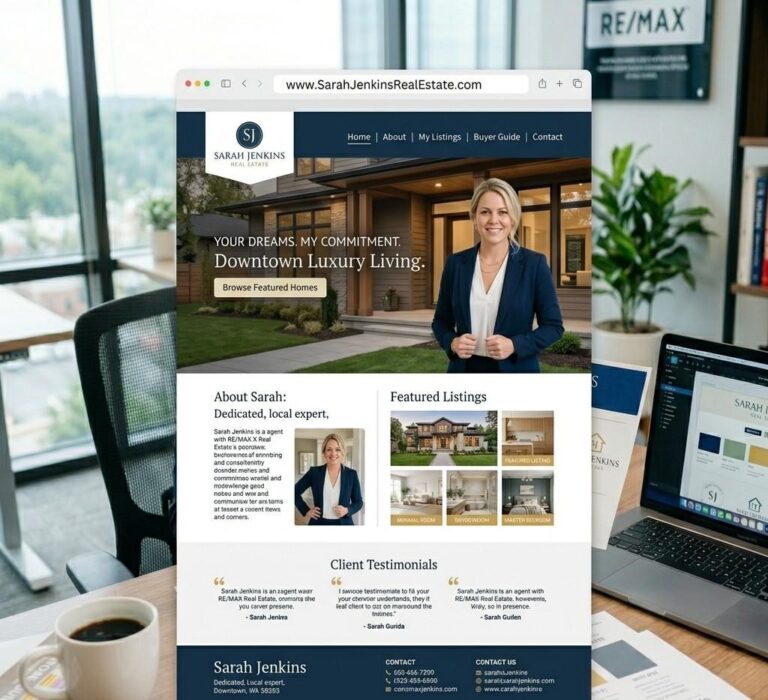

Quick answer — SEO for real estate agents means optimising your website and Google Business Profile so buyers and sellers find you in local search results before they find your competitors. The three foundations are location-based keyword targeting, a fully claimed and optimised Google Business Profile, and content that builds topical authority in your specific market area.
According to NAR’s 2025 Profile of Home Buyers and Sellers, 97% of home buyers used the internet during their search. Almost all of them started on Google. If your name does not appear when a buyer searches “homes for sale in [your city]”, that lead goes to the agent whose site does rank. SEO for real estate agents is how you stop that from happening.
- SEO for real estate agents focuses on location-specific keywords, not broad national terms.
- Your Google Business Profile is the fastest-return SEO asset you have as a realtor.
- Neighbourhood guide pages outrank generic service pages and generate more qualified leads.
- Realtor website SEO results typically take 3 to 6 months to show measurable organic traffic.
- Combining content strategy with local SEO for realtors produces compounding results over time.

Why SEO for Real Estate Agents Produces the Highest-Quality Leads
Paid ads stop the moment your budget runs out. SEO builds an asset that keeps working. A page that ranks for “3-bedroom homes in [your city]” in January still earns traffic in August, without any additional spend.
The quality difference also matters. A buyer who finds you through an organic Google search has already decided they want an agent in your area. They searched with intent. That makes organic search leads significantly easier to convert than cold outreach or broad social media traffic.
According to NAR’s 2025 Profile of Home Buyers and Sellers, 97% of buyers used the internet during their home search. The agents who capture that traffic early in the buyer journey build name recognition before competitors do. So by the time the buyer is ready to call someone, that agent is already familiar.
The full picture of how digital marketing works for real estate agents goes beyond SEO alone, but organic search is the channel where intent is highest and cost-per-lead is lowest over a 12-month horizon.
Local SEO for Realtors: Why the Map Pack Is Everything
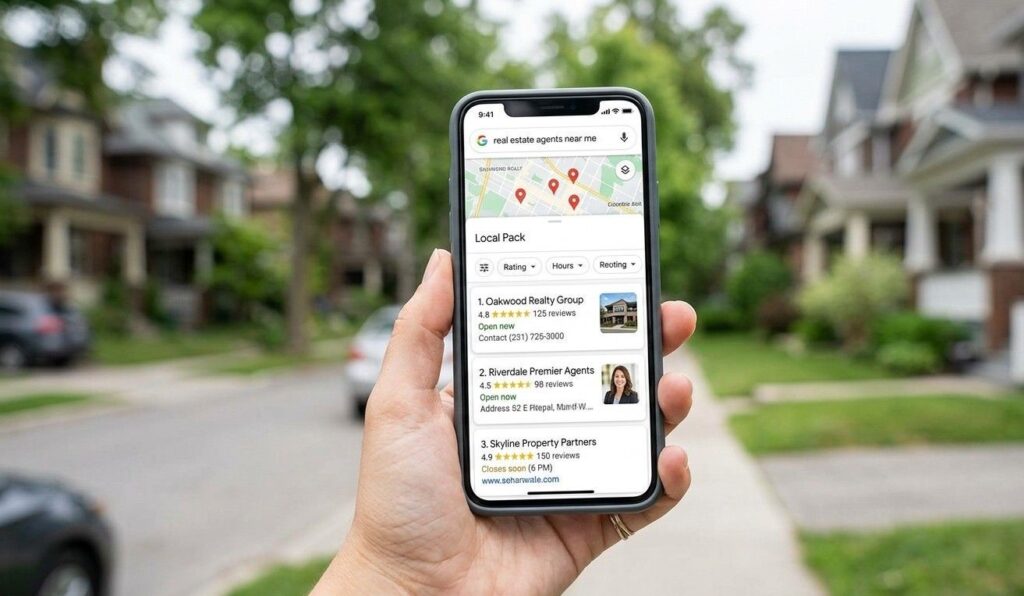
BrightLocal’s local SEO statistics show that Google’s local pack appears in 93% of searches with location intent. For a realtor, that means when someone searches “real estate agent near me” or “homes for sale in [city]”, a three-card map pack appears above all organic results. If you are not in it, you are invisible to most searchers.
Getting into the local pack requires three things. First, claim and fully complete your Google Business Profile. Fill every field: business category, service areas, hours, photos and a description with your city name included. Second, collect Google reviews consistently. The number and recency of reviews are direct ranking inputs. Five reviews from last year matter less than two reviews from last month. Third, make sure your name, address and phone number match exactly across every directory listing. Google cross-references this data to verify you are a real, legitimate business.
Local SEO for realtors also means earning citations: mentions of your business name and contact details on real estate directories like Zillow, Realtor.com, Homes.com and local chamber of commerce sites. Each consistent citation strengthens your local authority score.
Real Estate Keyword Strategy: Stop Targeting the Wrong Terms
Most realtors make the same keyword mistake. They target “real estate agent” or “homes for sale” — terms dominated by Zillow, Realtor.com and national portals with domain authority scores in the 90s. You will not outrank them. Your real estate keyword strategy needs to go specific.
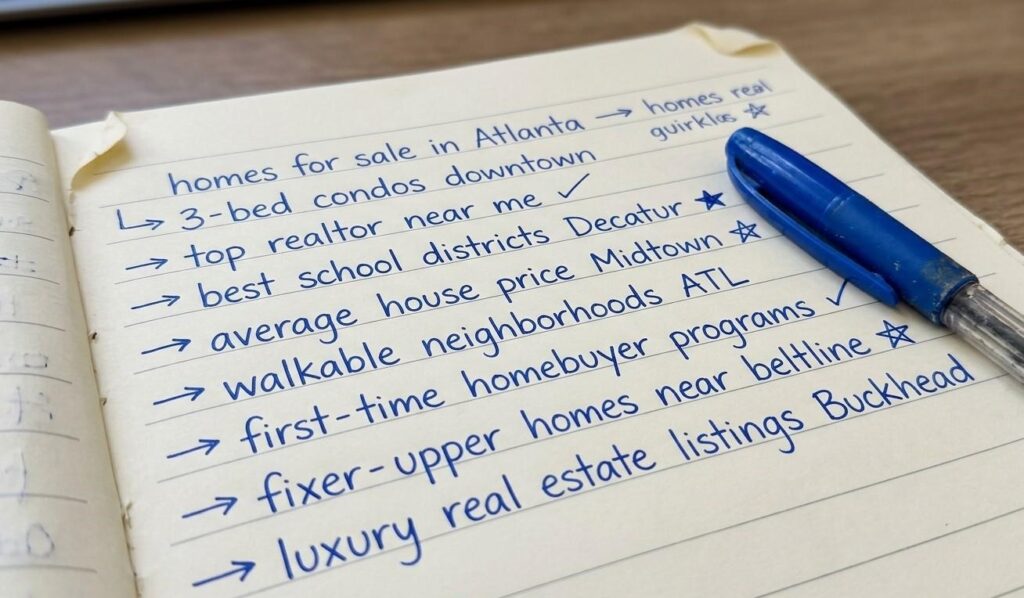
Target hyper-local terms instead. “Homes for sale in [neighbourhood]” and “[city] real estate agent” are searches you can actually win. The search volume is lower, but the conversion rate is dramatically higher because the searcher has already named where they want to buy or sell. A lead who searched “condos for sale in Queen Anne Seattle” is far closer to making a decision than someone who searched “condos for sale.”
Long-tail keywords also include service-specific phrases: “first-time home buyer agent in [city]”, “luxury home realtor [neighbourhood]” or “selling a home in [city] fast”. These convert well because they match a specific need. Use Google’s autocomplete and the “People also ask” box to find the exact phrases your market uses. Google Keyword Planner gives you real volume numbers at no cost.
Your real estate keyword strategy should also cover question-based searches. Buyers and sellers type questions, not just service terms. Pages that answer “how much does it cost to sell a home in [city]” rank for long-tail queries and build topical authority at the same time.
Realtor Website SEO: The On-Page Fixes That Move Rankings
Most realtor websites have the same structural problem: one generic homepage and a contact page, with nothing in between. That gives Google nothing to rank for specific searches. Realtor website SEO fixes this by building out your site architecture intentionally.
Start with your homepage title tag. It should read something like: “[Your Name] — Real Estate Agent in [City] | [Brokerage]”. Keep it under 60 characters. Include your city name. This is the single most-read element on your page from Google’s perspective.
Next, create dedicated pages for each area you serve. A page titled “Homes for Sale in [Neighbourhood]” with 400 to 600 words of original content about that area, local schools, commute times and recent sales data will rank for neighbourhood-level searches that your homepage never will. This is also where neighbourhood guide content earns its keep. BrightEdge research shows neighbourhood guide pages generate 3.2 times more leads than generic service pages.
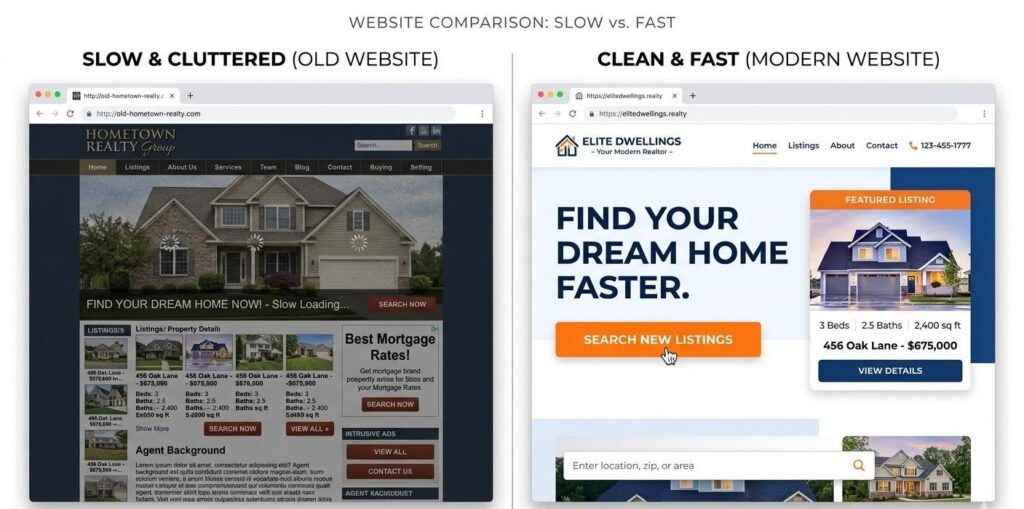
Also check your page speed. Google uses Core Web Vitals as a ranking factor. A realtor site loaded with large listing photos can fail the speed threshold badly. Use Google’s free PageSpeed Insights tool to diagnose the issue. Compress images to WebP format and defer non-essential scripts.
Topical Authority: The Content Strategy That Compounds Over Time
Google’s 2026 Helpful Content standards reward sites that cover a topic thoroughly over sites that publish a single article and stop. For realtors, topical authority means building a cluster of related content around your market area.
Start with a pillar page: a long-form guide to buying or selling a home in your city. This page links out to supporting posts on specific neighbourhoods, school districts, market trends and first-time buyer questions. Each supporting post links back to the pillar. This internal linking structure tells Google your site is the authority on real estate in that area.
One strong content type that realtors consistently overlook is the market update post. A monthly post titled “[City] Real Estate Market Update: [Month] 2026” targets buyers and sellers who are actively researching. It also gives you fresh, dateable content that signals your site is active.
If you want to go further, our post on social media ideas for real estate agents shows how to repurpose each blog post into platform-specific content, so the same research earns traffic from both Google and Instagram.
SEO for Real Estate Agents: DIY or Hire an Agency?
You can do the basics yourself. Claim your Google Business Profile, add your city to your title tags and write one neighbourhood guide this month. That alone puts you ahead of 60% of realtors in most markets, because most agents have done none of it.
However, consistent SEO requires ongoing work: monthly content, citation building, technical audits, link outreach and tracking what is actually ranking. That is a part-time job on top of a full-time sales role. Most agents who try to manage it solo get 3 weeks in and stop, which is exactly when consistency matters most.
An SEO agency removes that execution gap. A good agency brings keyword research tools, proven content frameworks and the ability to track rank changes week by week. For realtors in competitive urban markets, professional SEO for real estate agents accelerates results by 6 to 12 months compared to a solo effort.
Our SEO services for local businesses include keyword strategy, content production and Google Business Profile management. If lead generation is your priority alongside rankings, our lead generation service for real estate agents pairs with the SEO work directly.
Ready to Rank Higher and Win More Listings?
SEO for real estate agents is not a mystery. Fix your Google Business Profile, target hyper-local keywords and build neighbourhood content that matches what buyers are actually searching. When you are ready to accelerate that process, our real estate marketing team at Adnnel handles the strategy and execution. Book a free 30-minute call today and walk away with a custom keyword list for your market area.
Frequently asked questions
How long does real estate SEO take to work?
SEO for real estate agents typically produces measurable organic traffic growth within 3 to 6 months. However, competitive markets can take 9 to 12 months before you see consistent first-page rankings. The timeline depends on your starting authority, how much content you publish and how aggressively your competitors are investing in SEO. Start with your Google Business Profile because that can produce local pack visibility in 4 to 8 weeks.
What keywords should a real estate agent target?
Target hyper-local, intent-specific phrases rather than broad terms. Use your real estate keyword strategy to focus on searches like “homes for sale in [neighbourhood]”, “[city] real estate agent” and “first-time home buyer help in [city]”. These convert at much higher rates than generic terms. Google Autocomplete and the People Also Ask box are free tools that surface the exact phrases your local buyers and sellers are typing right now.
Is local SEO different for realtors?
Yes, local SEO for realtors is more geographically specific than standard local SEO. Your Google Business Profile service area, the city names in your page titles and the neighbourhood-level content on your site all carry more weight than they would for a general service business. Google wants to show buyers a relevant, trustworthy agent for their specific area. So your entire site architecture should reflect where you actually work, not where you aspire to work.
How do I optimise my realtor website for Google?
Realtor website SEO starts with four fixes: add your city to every title tag and H1 heading, create individual pages for each neighbourhood you serve, check your page speed with Google PageSpeed Insights and compress any oversized images. After those fixes, build your Google Business Profile and start collecting reviews. These six steps will move your rankings before you invest a cent in paid tools or an agency.
Should I hire an SEO agency or do it myself?
Do the basics yourself first: claim your Google Business Profile, fix your title tags and write one neighbourhood guide. Then track your rankings for 60 days. If you are improving, keep going. If you are stuck or lack time for consistent content production, hiring an SEO agency for real estate agents accelerates results significantly. Agencies bring tools, frameworks and execution consistency that most solo realtors cannot maintain alongside a full client load.
What is topical authority in real estate SEO?
Topical authority means Google recognises your site as the most thorough, reliable source on real estate in your specific area. You build it by publishing a cluster of related content: a pillar guide to buying or selling in your city, supporting posts on specific neighbourhoods, school districts and market trends, all interlinked. SEO for real estate agents with strong topical authority ranks faster for new pages and holds rankings longer during Google core updates.

![A close-up, photorealistic shot, from an over-the-shoulder perspective, of a hand holding a modern smartphone in a bright, local neighborhood cafe. The screen is sharply focused, displaying a Google Business Profile for "Sarah Johnson, [Your City Name] Realtor." The profile is complete with a smiling professional headshot, five large gold stars indicating a top rating, and a clear "Local Expert" verification badge. Subtle natural daylight filters in from a large window to the side, highlighting the hand and phone screen. Shallow depth of field blurs the cafe background (wooden tables, plants) into soft bokeh. The overall feel is warm, authentic, and focused.](https://adnnel.com/wp-content/uploads/2026/05/1-7-768x448.jpeg)