
Quick answer — GEO for real estate agents stands for Generative Engine Optimization: the process of structuring your website content and online presence so that AI search tools like ChatGPT, Perplexity and Google AI Overviews cite you by name when buyers and sellers ask local real estate questions. Unlike traditional SEO, which targets Google’s blue links, GEO targets the AI-generated answers that now sit above those links. Realtors who start building their GEO presence now are earning citation share that late adopters will struggle to close.
A buyer types ‘best realtor in [your city]’ into ChatGPT and gets three agent names back. Yours is not one of them. That is GEO for real estate agents in action, except you are on the wrong side of it. Traditional SEO still matters, but in 2026 the first answer a buyer sees often comes from an AI engine, not a Google results page.
- GEO for real estate agents means optimising your content so AI tools cite you, not just rank you.
- According to NAR’s 2025 Profile of Home Buyers and Sellers, 52% of buyers found their home online, making digital visibility more important than ever.
- AI engines pull from Google Business Profiles, third-party review sites, brokerage bios and neighbourhood guide pages.
- A well-structured neighbourhood guide page on your website is your single strongest GEO asset.
- Realtors who built GEO authority in early 2025 now hold a citation advantage that later entrants spend far more to close.

What Is GEO for Real Estate Agents?
While broader Generative Engine Optimization for local businesses applies across all service industries, in real estate it is the practice of making your local market content easy for AI language models to find, read and cite. When someone asks Google AI Overviews, ChatGPT or Perplexity a real estate question, those tools generate an answer from sources they trust. GEO for real estate agents is the work of making your website and profiles one of those trusted sources.
The key difference from traditional SEO is the output. SEO puts you on page one of Google so humans click through to your site. GEO puts your name, your expertise and your local knowledge inside the AI answer itself. Sometimes the AI links back to you. Sometimes it just quotes your content. Either way, the buyer or seller hears your name before they have seen any other agent.
This matters because AI search is not a fringe habit. Google AI Mode rolled out to all US searchers in 2025. Perplexity processes tens of millions of real estate queries each month. ChatGPT added real-time search in late 2024. So the pipeline your future clients use to find an agent now runs through these tools, not just through a Google results page full of Zillow and Realtor.com.
The good news is that GEO does not require a new website or a new brand. It requires restructuring content you probably already have so AI engines can extract and cite it clearly.
How AI Search Is Changing Real Estate Leads
According to NAR’s 2025 Profile of Home Buyers and Sellers, 52% of buyers found their home online and 88% used a real estate agent at some point in the process. Buyers start online and end with an agent. The question GEO answers is: which agent do they find first?
AI engines change the lead funnel in two ways. First, they compress the research phase. A buyer who used to spend two weeks reading listings and blog posts now asks ChatGPT three targeted questions and moves to a shortlist. Second, they change how agent recommendations form. A buyer who asks ‘who is the best agent for first-time buyers in Austin?’ and gets two names from an AI is far more likely to contact one of those two agents than to run a fresh Google search.
The counterintuitive part: AI search visibility and Google rankings are increasingly separate. Research from Starmorph tracking AI Overview citations in early 2026 found that 31% of AI-cited pages ranked below position ten in organic search. That means an agent whose neighbourhood guide does not rank number one on Google can still get cited by Google AI Overviews if that content is structured correctly and carries clear authority signals.
For realtors, this creates an opening. The big portals like Zillow and Realtor.com dominate traditional search. They do not always dominate AI citation because AI engines weight local expertise, specific answers and named authorship more heavily than domain authority alone.

What Content Do AI Engines Cite for Real Estate Queries?
AI tools are not random. They pull from a predictable set of source types and you can engineer your presence in each one.
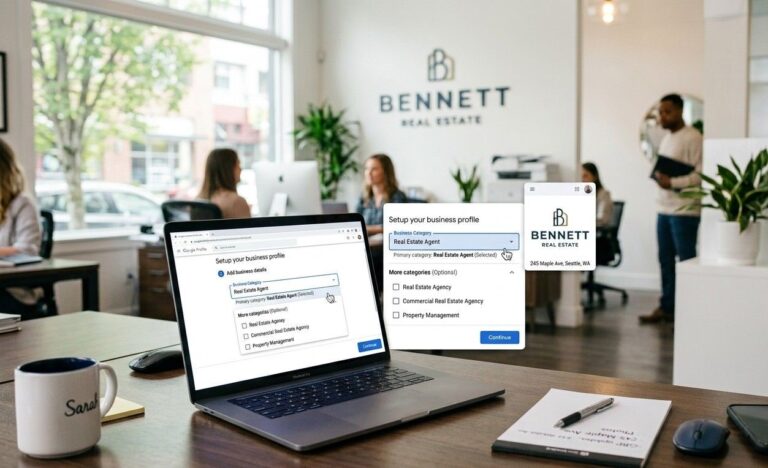
Your Google Business Profile is the single most influential signal for local AI recommendations. Complete every field: services, service areas, hours, photos and a detailed description that names the neighbourhoods you serve. AI engines read GBP data directly. An incomplete profile means AI tools have less to work with and less reason to cite you.
Third-party directories carry more weight in 2026 than they did two years ago because AI tools use them as corroborating sources. Expertise.com, ThreeBestRated.com, Zillow agent profiles and Yelp reviews all appear in AI citation chains. Claim and complete every profile you can find. Make sure the name, address and phone number match exactly across all of them.
Your own website content does significant heavy lifting for GEO, but only if it is structured to answer specific questions. A page titled ‘Austin Buyer Agent’ does very little. A page titled ‘What Is the Average Price of a Three-Bedroom Home in South Austin?’ does a lot. AI engines match content to queries. Write pages that match the exact questions your buyers and sellers are typing into AI tools.
Finally, brokerage bio pages and press mentions both contribute. If your brokerage profile is empty or generic, update it now. A single quote in a local news article about market conditions can become an AI citation within weeks.
How to Get Your Real Estate Website Into Google AI Overviews
Build neighbourhood guide pages
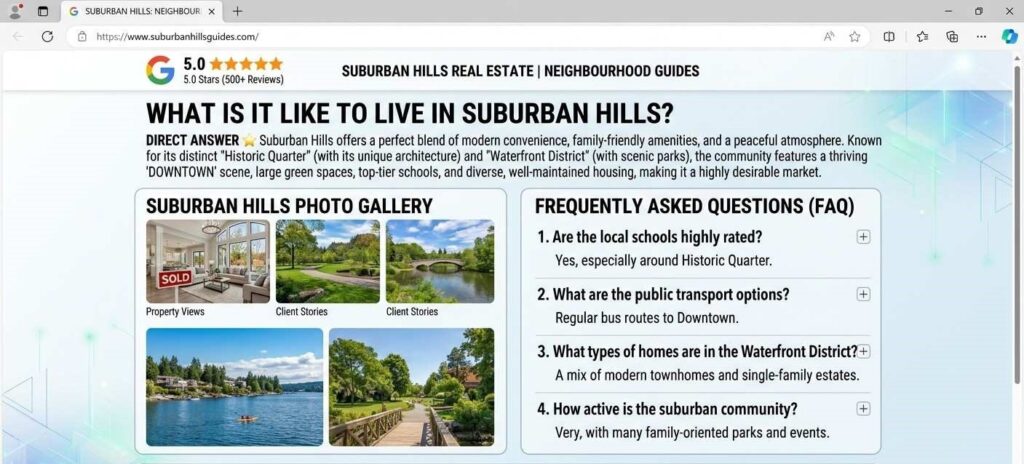
A neighbourhood guide is a page on your website dedicated to a single area you serve. It answers the questions buyers actually ask: What are property values doing? What are the schools like? What does the commute look like? How competitive is the market right now? Write each answer in clear, direct prose with a date. AI engines prioritise freshness, so update each guide quarterly.
Add FAQ markup and author attribution
Google’s own documentation confirms that structured FAQ markup helps AI systems extract answers from your pages. Add a FAQ section to every neighbourhood guide and every market update post. Each question should be 10 words or fewer and each answer should be 40 to 80 words. Keep the language direct and factual.
Author attribution matters equally. Google’s 2026 spam updates penalise anonymous content. Every page and post on your site should carry your name, your licence number and a short bio. AI engines use author signals as a trust filter. A named, credentialed agent beats an anonymous website every time in the citation race.
Is GEO Replacing Traditional Real Estate SEO?
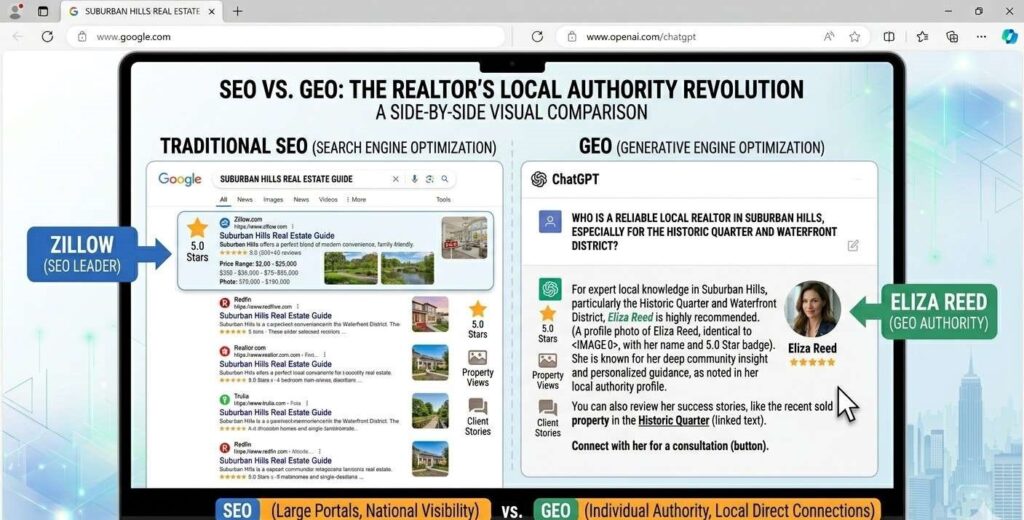
No, and this distinction matters. GEO and traditional SEO for real estate agents work on different outputs but share much of the same input. A well-structured, authoritative page that answers specific questions performs well in both organic rankings and AI citation. So the work overlaps significantly.
The difference is in emphasis. Traditional SEO rewards keyword density, backlink quantity and page authority. GEO rewards directness, named expertise and answer completeness. A page that ranks number four for ‘Austin real estate agent’ because it has strong backlinks may get zero AI citations if it does not clearly answer a specific question. A page that answers ‘what is the average days on market in Mueller, Austin this quarter’ precisely may get strong AI citation even from position twelve.
The practical conclusion: invest in both, but shift your content creation toward specific, question-led pages. Our SEO, GEO and AEO services are built around exactly this strategy, combining traditional ranking work with the structural optimisation that earns AI citations.
How Soon Can a Realtor See Results from GEO?
The honest answer is four to twelve weeks for initial citation appearances and three to six months for meaningful citation volume. AI engines re-index content at different speeds. Google AI Overviews can pick up a well-structured page within days of it being indexed. Perplexity and ChatGPT tend to take longer because their model updates happen on a different schedule.
The fastest results come from your Google Business Profile. A complete, photo-rich profile in a market with low competition can appear in local AI recommendations within two to three weeks of being fully optimised. This is where most realtors should start because the effort is low and the citation speed is high.
Neighbourhood guide pages on your own site take longer. Expect four to eight weeks from publication to first AI citation, assuming your site has at least some existing authority. Pages on sites that have never been cited before take longer still.
The timeline compresses when you combine GEO work with active review generation and consistent content publication. Our real estate marketing agency team builds these three tracks in parallel so citations start building from multiple directions at once.
Start Building Your AI Search Presence Now
GEO for real estate agents is the single biggest shift in digital marketing since local SEO became standard practice, and the agents who act first will hold the citation advantage for years. Your Google Business Profile, your neighbourhood guides and your named, structured content are the assets that put you inside the AI answers your future clients are already reading. Contact Adnnel for a free GEO audit and a clear action plan built around your specific market and the leads you want to win.
Written by Wajahat
Frequently asked questions
What is GEO for real estate?
GEO for real estate stands for Generative Engine Optimization. It is the process of structuring your website content and online profiles so that AI tools like ChatGPT, Perplexity and Google AI Overviews cite you by name when buyers or sellers ask local real estate questions. It differs from traditional SEO because it targets AI-generated answers, not just Google’s blue links. The goal is to get your name into the answer, not just the rankings.
How does AI search affect real estate leads?
AI search compresses the buyer research phase and changes how agent recommendations form. A buyer who asks ChatGPT ‘who is the best buyer’s agent in Dallas’ and gets two names will likely contact one of those two before running any other search. GEO for real estate agents is the work of making sure your name appears in those AI-generated answers. Agents who appear in AI citations close more first-contact inquiries because the buyer arrives pre-warmed rather than cold.
How do I get my real estate website in Google AI Overviews?
Write neighbourhood guide pages that answer specific, common buyer and seller questions directly and clearly. Add FAQ markup to those pages and include your name, licence number and a short bio on every page. Keep your Google Business Profile fully complete with updated photos, service areas and recent posts. Google’s AI Overviews prioritise content that answers a question directly, carries a named author and comes from a site with consistent recent activity. GEO for real estate agents starts with these three foundations.
Is GEO replacing traditional real estate SEO?
No. GEO and traditional SEO share most of the same inputs: well-structured, authoritative content that answers specific questions. The difference is in emphasis. Traditional SEO rewards backlink quantity and keyword placement. GEO rewards directness, named expertise and complete answers. Combining an effective SEO strategy for real estate agents with GEO is the smartest approach in 2026, because pages that perform well on one tend to perform well on the other when built correctly from the start.
What content do AI engines cite for real estate queries?
AI engines pull from Google Business Profiles, third-party review directories like Expertise.com and Yelp, brokerage bio pages, local news mentions and your own website content. For your site, the most-cited pages answer specific buyer and seller questions directly: current average prices in a neighbourhood, days on market, school district comparisons. Generic agent bio pages rarely get cited. Specific, question-led content with a named author gets cited far more often in real estate queries.
How soon can a realtor see results from GEO?
A fully optimised Google Business Profile can appear in local AI recommendations within two to three weeks of completion. Neighbourhood guide pages on your own site typically earn their first AI citations four to eight weeks after publication, assuming your site has some existing authority. Full citation volume, meaning regular appearances across multiple AI tools for multiple queries in your market, builds over three to six months. GEO for real estate agents rewards early movers disproportionately, so starting now beats starting later at any budget level.