Quick answer — The best Google Ads targeting strategy for restaurants combines radius targeting (1 to 5 miles), ad scheduling around peak meal times and high-intent keywords like “Thai food near me open now.” Use Search campaigns for intent-based discovery, call extensions to drive reservations and call-only ads during busy service hours. According to Think with Google (2024), 76% of people who search “near me” on mobile visit a business within 24 hours, so every ad you serve to a local, hungry customer is a table-filling opportunity.
Your lunch rush starts in two hours. Right now, thousands of people within a mile of your restaurant are pulling out their phones and typing “pizza near me open now.” A solid google ads targeting strategy for restaurants puts your name at the top of that search, at that exact moment, for roughly $2.05 per click. Here is how to build it.
- A google ads targeting strategy for restaurants should focus on radius targeting, peak-hour scheduling and high-intent keywords to reach local customers.
- Search campaigns work best for new customer discovery because they capture active intent at the moment someone is ready to eat.
- Call-only ads drive direct phone reservations and work especially well during dinner service when people want a table fast.
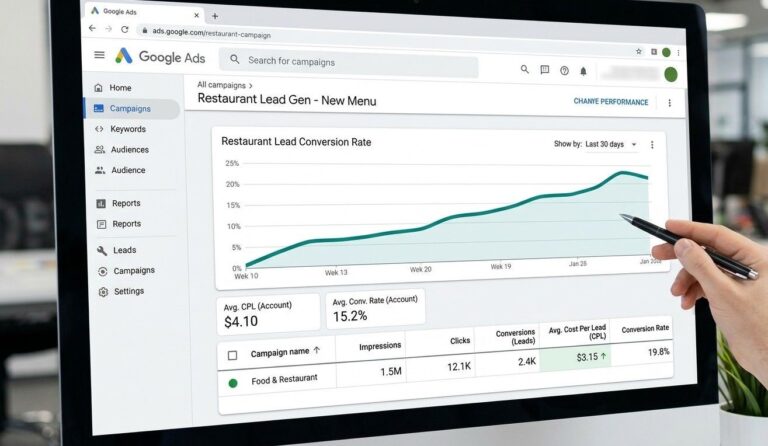
- WordStream’s 2026 benchmark report shows restaurants enjoy one of the lowest average costs per lead of any industry at $30.27, making paid search a smart spend.
- Tracking phone calls from Google Ads tells you which campaigns actually fill seats, not just which ones get clicks.
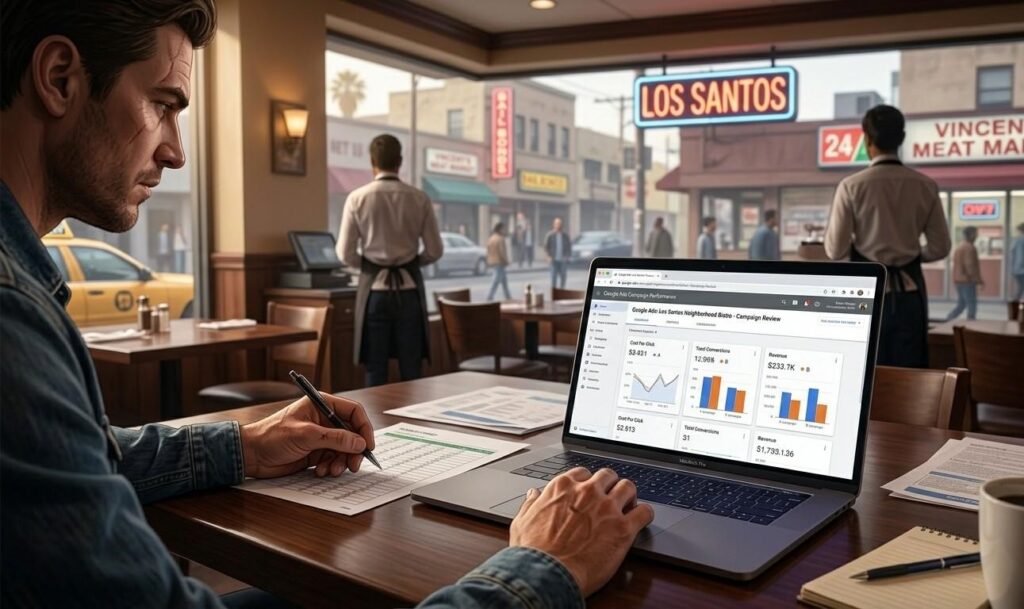
Why Google Ads Targeting Strategy for Restaurants Is Different From Other Businesses
Most local businesses can afford to wait a few days for a lead to convert. Restaurants cannot. You are competing for someone who is hungry right now, within walking or driving distance of your front door, and will decide in the next 10 minutes where they eat. That urgency changes how you should set up every part of your campaign.
The first thing to understand is that restaurant Google Ads live and die on timing and proximity. A law firm can show ads all day because consultations can happen any week. Your ads should run hard during the 90 minutes before your service windows and pull back overnight when your kitchen is closed. Paying for clicks at 2am when you open at 11am is just money out the window.
The second thing is the search volume. According to Think with Google (2024), 76% of people who search “near me” on mobile visit a business within 24 hours. For a restaurant, that is not a marketing metric. That is a seat in your dining room. Every local search impression you miss is a cover you did not fill—and while paid ads drive instant table bookings, mastering SEO for restaurant websites ensures you capture organic local searches as well.
The Campaign Types That Actually Work for Restaurants
Search Campaigns: Your Bread and Butter
Search campaigns show text ads when someone types a specific query into Google. For restaurants, this is where you capture the hottest intent. Someone who types “best tacos near me” is not browsing. They are five minutes from making a decision. Your ad for “Authentic Street Tacos in Austin, Open Until 11pm” shows up, they click, and they book.
The key is matching your ad message to the intent signal in the search. Understanding how to write Google Ads copy that actually converts for local businesses ensures your headlines and descriptions directly trigger reservations. If they search by cuisine type, your headline should name that cuisine first. Google’s Responsive Search Ads let you feed in multiple headlines and descriptions, then it tests combinations for you. Use this feature. Fill all 15 headline slots with specific, accurate claims about your restaurant.
Performance Max Campaigns: Use With Caution
Performance Max runs your ads across Search, Display, YouTube, Maps and Gmail automatically. Google pushes it hard. For restaurants, treat it as a secondary campaign, not your main one. It spends budget on placements you cannot control, which means your ad might show up on a YouTube video about cooking rather than in front of someone who is actively hungry. Start with Search campaigns first to capture active search intent. If you want to build visual awareness on social channels alongside search ads, explore our guide to Facebook Ads for restaurants. Our full guide to restaurant marketing strategy covers how these campaign types fit into a broader growth plan.
Radius and Location Targeting: The Settings Most Restaurants Get Wrong
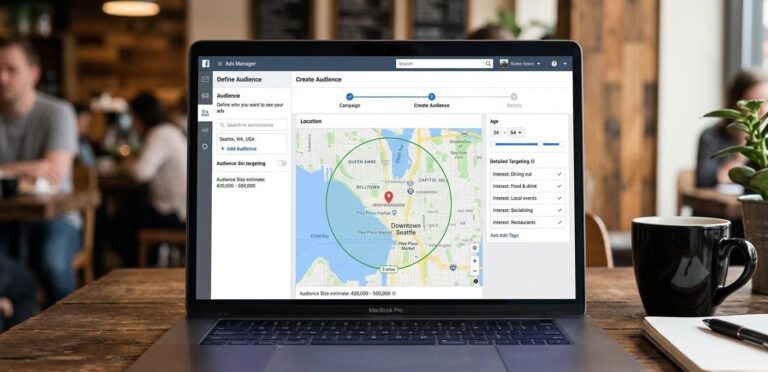
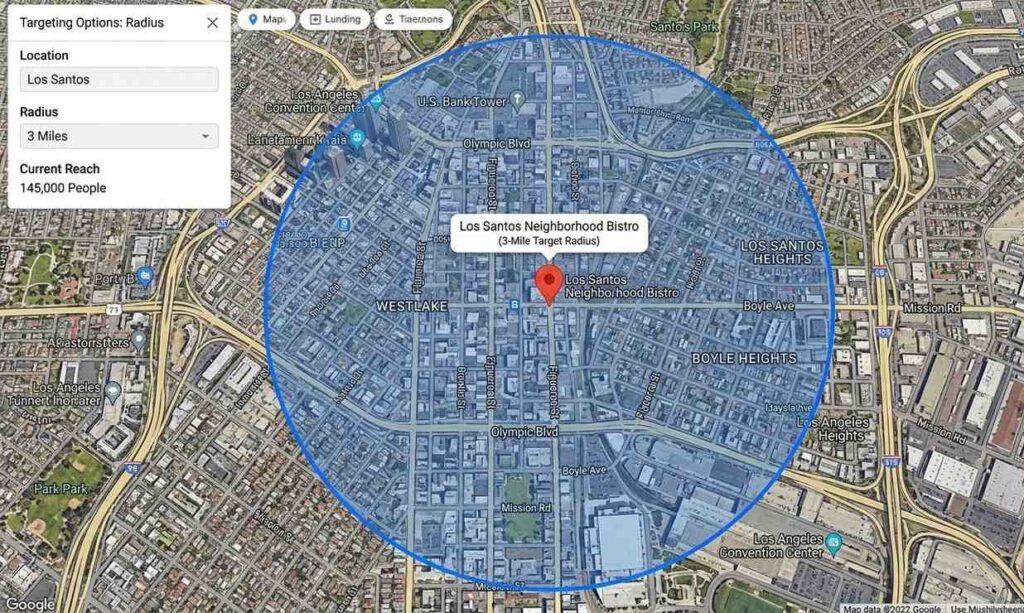
The default Google Ads location setting targets an entire country. Nobody building a restaurant campaign should leave that default in place. Go to your campaign settings, click Location, and set a radius around your physical address. Most full-service restaurants do well with a 3 to 5 mile radius in urban areas and up to 8 miles in suburban areas where people drive further for a meal. Fast-casual spots in dense cities can go as tight as 1 mile.
There is a second setting inside location targeting that most people miss. Under the Advanced options, you will see “Presence, search interest, or people who show interest in your targeted locations.” Change this to “Presence: People in or regularly in your targeted locations.” The default setting wastes budget on people who just searched about your city from 300 miles away.
Also layer in bid adjustments by location. If your restaurant sits next to a convention center or university, increase your bids for that specific zip code. Google lets you adjust bids up or down by percentage for any sub-location within your campaign. This is one of the quickest wins in any lead generation setup for local businesses and restaurants are no exception.
Ad Scheduling: Run Ads When People Are Actually Ready to Eat
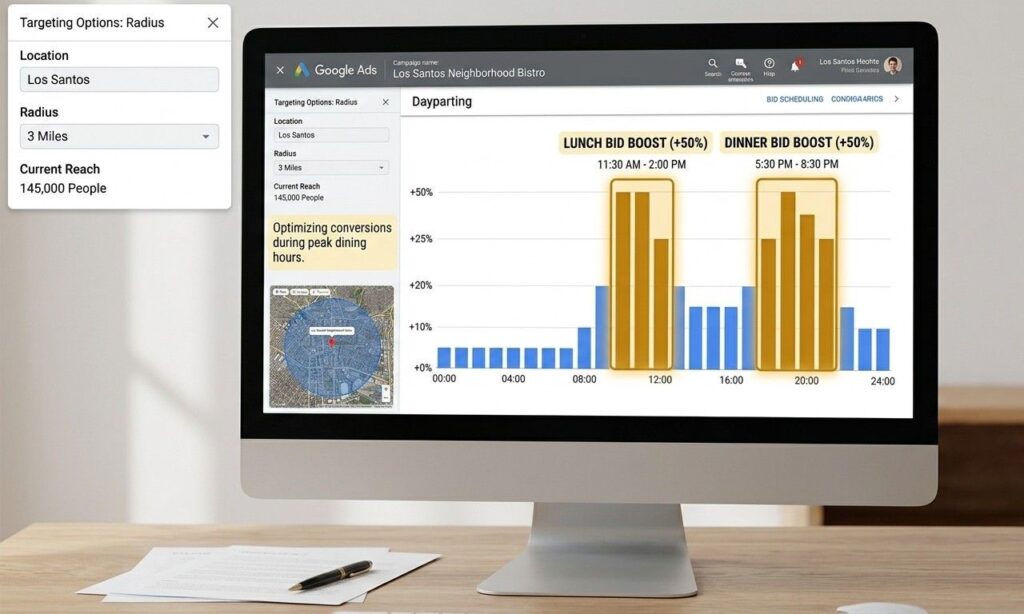
Ad scheduling, called dayparting in PPC circles, lets you run ads only during certain hours or increase bids at peak times. For most restaurants, the highest-intent windows are 10:30am to 1:30pm (lunch) and 4:30pm to 8:30pm (dinner). These are the moments when someone shifts from “I’m getting a little hungry” to “I need to find somewhere to eat right now.”
According to WordStream’s 2026 Google Ads benchmark report, the average CPC for Restaurants and Food is just $2.05, one of the lowest of any industry tracked. That means even a modest daily budget of $15 to $20 gets you meaningful impressions during peak windows. The math works. $20 a day at $2.05 per click gives you roughly 10 clicks per day. If 3 of those turn into reservations or walk-ins, and each table averages $60 in spend, you just made $180 on a $20 investment.
Set your baseline schedule to run during meal windows only. Then increase bids by 20 to 30% during the 30 minutes right before your peak hours, when decision-making is at its sharpest. You can do this inside the ad schedule settings using bid adjustments. Review your hourly data every two weeks and shift your schedule based on what the data actually shows for your location, not industry averages.
Keywords That Bring In Hungry Diners, Not Casual Browsers
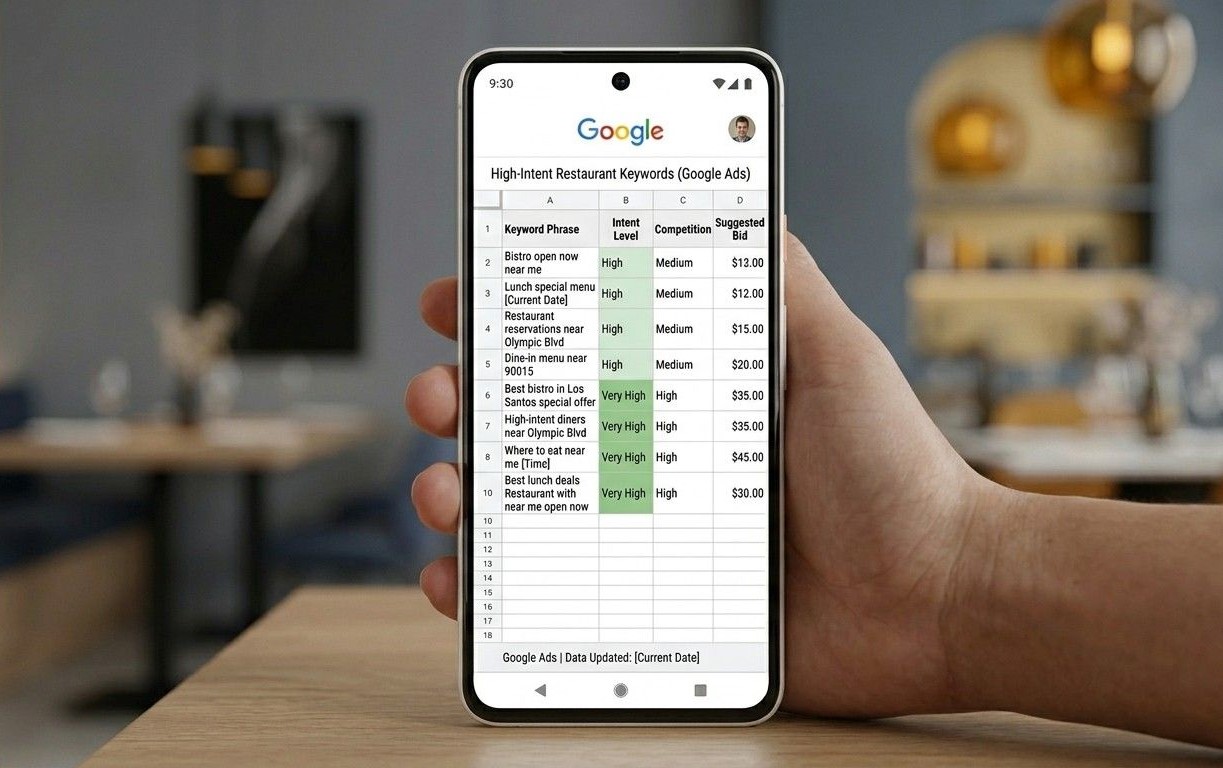
Your keyword strategy should focus on high-intent, location-aware phrases. The best performers for restaurant Google Ads targeting consistently include cuisine-plus-location combinations (“Italian restaurant downtown Denver”), urgency modifiers (“open now,” “near me,” “lunch today”) and occasion triggers (“date night restaurants,” “birthday dinner,” “family brunch”). These are searches from people who are actively deciding, not passively browsing.
Use phrase match and exact match for your core terms. Avoid broad match until you have at least 30 days of search term data to review. Broad match will spend your budget on searches like “restaurant recipes” or “how to cook pasta” because they are loosely related to food. Pull your search terms report weekly and add irrelevant terms as negative keywords immediately.
One keyword tactic worth testing: bid on your competitors’ names. If someone searches “[Competitor Name] reservations” and that spot is full, your ad for “[Your Name], table available tonight” can intercept that traffic. It is legal, fairly common and can be effective. For a broader look at how paid search fits into the full restaurant digital marketing picture, see our guide on Google Ads for restaurants.
Call Extensions and Call-Only Ads: Turning Searches Into Reservations
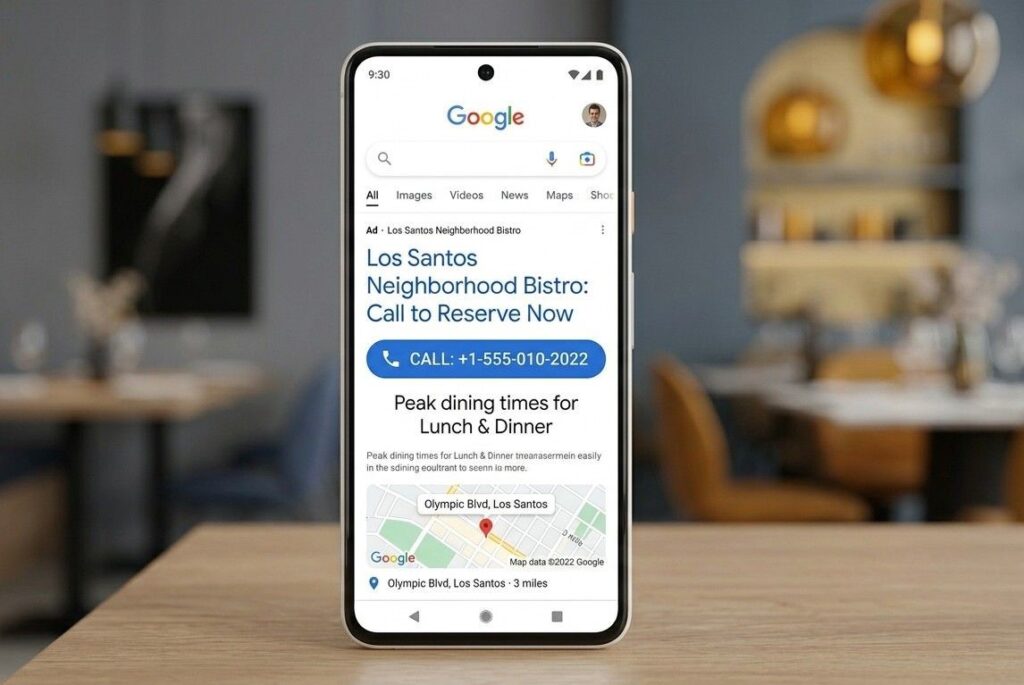
Call extensions add your phone number directly to a Search ad. On mobile, users tap the number and call without ever visiting your website. For reservations, this is the shortest possible path from ad impression to paying customer. Add call extensions to every restaurant Search campaign. Set them to run during your business hours only.
Call-only ads are a step further. The entire ad is a phone number and a headline. There is no website click. The user sees your name, a short description and your number. When they tap, they call. These ads work especially well during dinner service when someone wants a table in the next hour and has no patience for a booking form. Set call-only ad campaigns with a separate budget and let them run from 5pm to 9pm on weekdays and all day on weekends.
The important piece that ties all of this together is call tracking through Google Ads. When you enable call reporting in your account, Google tracks how long each call lasts. A 30-second call probably means the caller got an answer and hung up. A 3-minute call almost always means a reservation. Set your conversion threshold to calls over 90 seconds to count only the ones that actually produced a booking. This data tells you which campaigns are filling seats versus which ones are just generating noise.
Start Filling Tables with Smarter Google Ads
A focused google ads targeting strategy for restaurants does not need a big budget. It needs the right radius, the right schedule and keywords that match what hungry diners actually type. If you want hands-on help building campaigns that are tracked, optimized and genuinely tied to reservation volume, our Google Ads management team at Adnnel specializes in exactly this. Reach out today and we will audit your current setup for free before touching a single dollar of your budget.
Written by Wajahat
Frequently asked questions
What Google Ads campaign type works best for restaurants?
Search campaigns work best for restaurants because they capture high-intent local customers who are actively looking for a place to eat right now. A well-structured google ads targeting strategy for restaurants starts with Search, using cuisine-specific keywords plus location and time modifiers. Once you have 30 days of conversion data, you can test Performance Max as a secondary campaign to extend your reach across Google Maps and Display.
How do I target people near my restaurant with Google Ads?
Set a radius around your restaurant’s address in the Location settings of your campaign. Most restaurants use 3 to 5 miles for urban areas and up to 8 miles for suburban locations. Also change the advanced setting from the default to “Presence: People in or regularly in your targeted locations.” This stops your budget from going to users who just searched about your area but are nowhere nearby.
What is a call-only ad and should restaurants use it?
A call-only ad is a Google Ads format where the entire ad is a tappable phone number. There is no website link. The user taps and calls directly from the search results page. Restaurants should absolutely use call-only ads during peak service hours. They are the fastest route from ad impression to reservation. Schedule them for your busiest windows, typically dinner service on weekdays and all day on weekends.
How do I use Google Ads to promote a lunch special?
Create a separate ad group inside your Search campaign specifically for lunch keywords. Use phrases like “lunch near me,” “lunch special today” and your cuisine plus “lunch deals.” Write ad copy that names the special directly: “$12 Pasta Lunch Special, Open 11am.” Run these ads from 10am to 2pm only using ad scheduling. Link to a landing page that shows the special prominently with a call or booking button above the fold.
What is a good click-through rate for restaurant ads?
According to WordStream’s 2026 Google Ads benchmark data covering over 13,000 campaigns, the average CTR across all industries is 6.66%. Restaurants with well-written, specific ads targeting high-intent local keywords should aim for 7 to 10% CTR. Ads that mention a specific cuisine, price point or time modifier (“open now”) typically outperform generic ads. A google ads targeting strategy for restaurants focused on tight keyword match types will push CTR higher than using broad match keywords.
How do I track phone calls from Google Ads?
Enable call reporting in your Google Ads account under Tools, then Conversions. Set up a new conversion action for phone calls from ads and choose a minimum call duration, 90 seconds is a good starting point for restaurants, so only meaningful conversations count as conversions. Google assigns a forwarding number to your ad. When someone calls it, Google logs the call and matches it back to the campaign, ad group and keyword that triggered it. Review call data weekly.