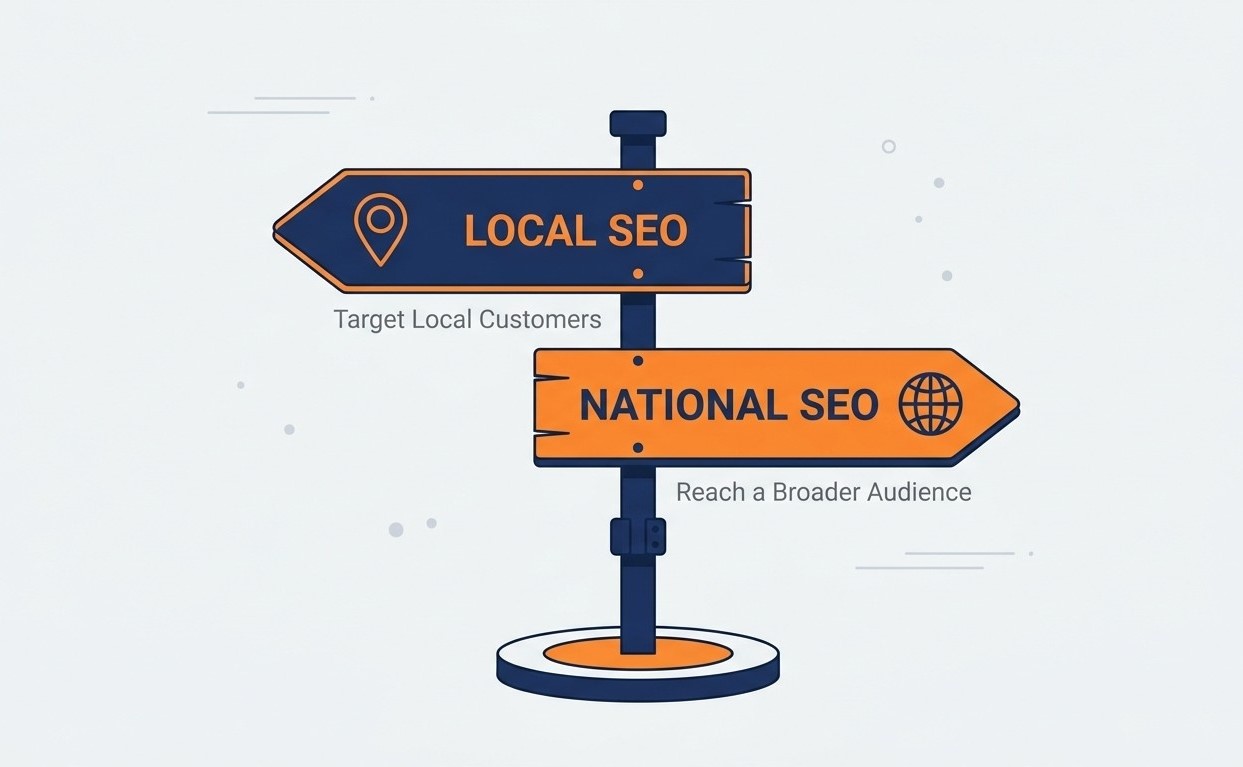
Quick answer — Local SEO targets customers in a specific city or region using Google Business Profile, map rankings and location-based keywords. National SEO targets audiences across an entire country with broad keyword campaigns and high-authority content. Most small businesses, including restaurants and real estate agents, need local SEO vs national SEO resolved in favour of local because geography drives their revenue, not nationwide brand reach.
Key Takeaways
- Local SEO wins for any business where customers live, eat or buy within a defined area.
- National SEO makes sense only when your product or service sells anywhere in the country.
- Local SEO vs national SEO is not just a budget question: the tactics, timelines and metrics are completely different.
- Restaurants and real estate agents almost always need local SEO, not national campaigns.
- You can layer a local SEO foundation first, then scale nationally once you dominate your market.
A restaurant owner in Austin and a software company in the same city both need SEO. But the moment they start using the same strategy, one of them is burning money. Local SEO vs national SEO is the first decision that shapes every dollar you spend on search, and most business owners get it wrong by defaulting to whichever term they heard first.
What Is Local SEO and How Does It Actually Work?
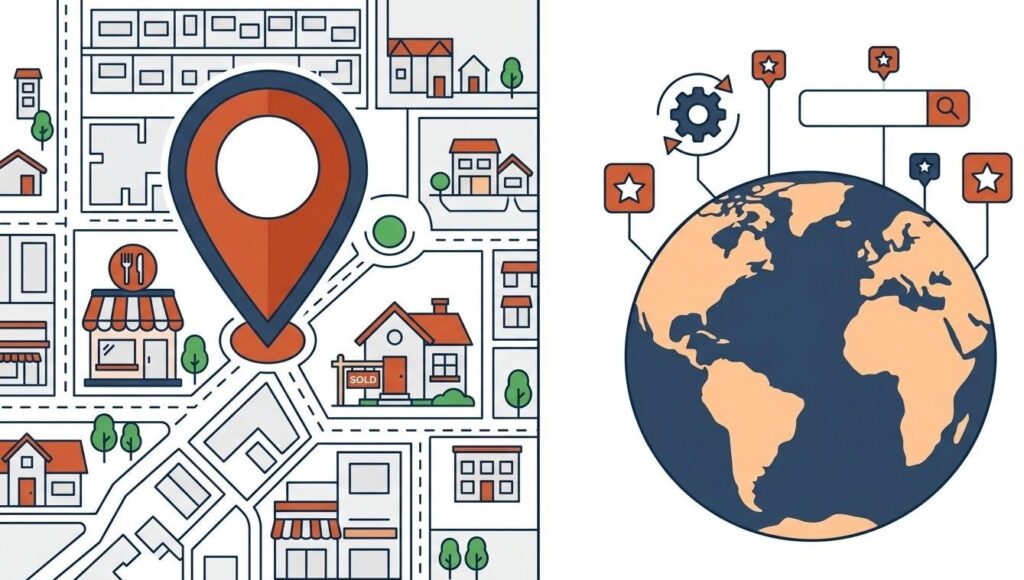
Local SEO is the practice of ranking your business in search results that are tied to a specific geographic area. When someone searches for “best pizza near me” or “real estate agent in Denver,” Google serves results based on the searcher’s location. Your Google Business Profile, local citations and proximity to the searcher all determine where you land.
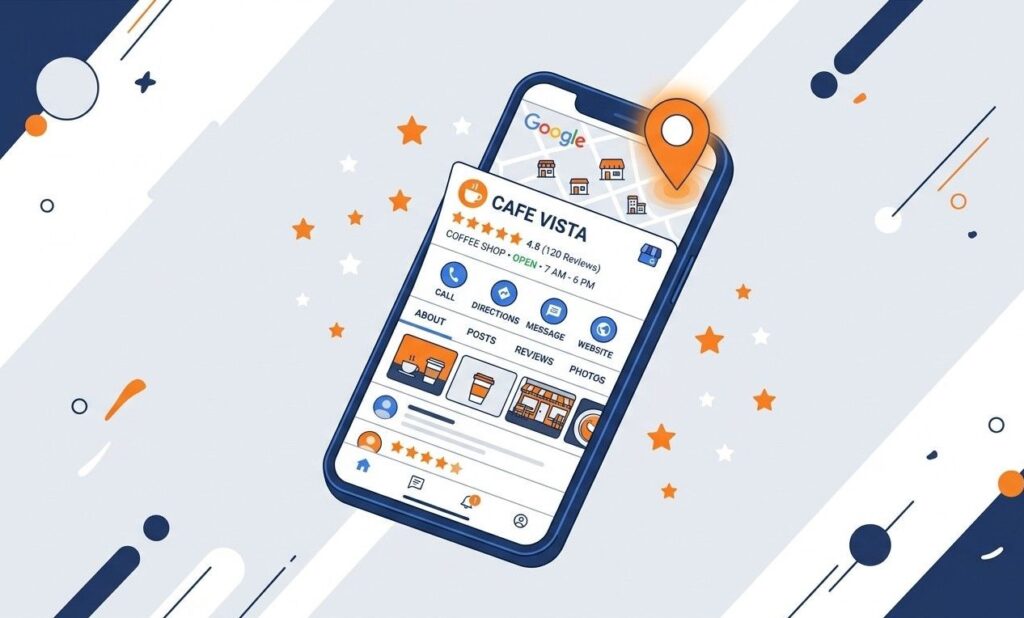
The mechanics are different from standard SEO. Google runs a separate local algorithm called the “Local Pack,” which powers the three-map-result block you see at the top of most location-based searches. To rank there, you need a complete Google Business Profile, consistent NAP (name, address, phone) data across directories and reviews that signal trust to Google.
Here is the part most guides skip: local SEO also includes your website’s organic rankings for geo-modified keywords. So ranking for “Italian restaurant Chicago” in the regular blue links is also local SEO. The two systems, the Local Pack and organic local rankings, reinforce each other when you build them together.
According to BrightLocal’s 2026 Local SEO statistics, 45% of consumers now use ChatGPT or generative AI tools to find local business recommendations. That means your local SEO must now feed AI engines, not just Google. Visibility in AI-generated local recommendations is 30 times harder to achieve than ranking in Google’s local results, per the same report.
What Is National SEO and When Does It Make Sense?
National SEO targets a broad, location-agnostic audience. You want to rank for “best project management software” or “how to file taxes online” regardless of where the searcher sits. The competition is steeper, the timelines are longer and the content requirements are far more demanding.
A national campaign requires building topical authority at scale. That means publishing hundreds of pieces of content, earning backlinks from high-domain-authority sites and competing against brands that may have been building their SEO moat for a decade. For a small business, that is a very expensive war to enter without a clear path to win.
National SEO does make sense in specific situations. E-commerce stores that ship anywhere in the country need it. SaaS companies, online education platforms and any brand where the customer’s physical location is irrelevant should pursue it. So should businesses in markets so small that local search volume cannot sustain growth.
The mistake small business owners make is assuming national SEO equals more visibility. In practice, a solo realtor in Phoenix who tries to rank nationally for “buy a house” will be invisible. The same realtor who dominates “homes for sale in Scottsdale” will generate actual leads within months.
Local SEO vs National SEO: The Real Differences That Matter
Timeline and competitive difficulty
Local SEO produces measurable results faster. A well-optimized Google Business Profile can move into the top three map results within 60 to 90 days in moderately competitive markets. National SEO typically takes 6 to 18 months before organic rankings show meaningful movement.
The reason is competition. For a local query like “Mexican restaurant in Nashville,” you compete against maybe 20 to 50 local businesses. For a national query like “best Mexican restaurant,” you compete against thousands of established domains with years of authority built up.
Cost and effort
Local SEO is cheaper per meaningful result. You need a complete Google Business Profile, consistent citations across directories like Yelp and TripAdvisor, a review acquisition process and locally-focused content on your website. These are achievable for most small business budgets.
National SEO requires ongoing investment in content production, link building and technical infrastructure. The monthly cost for a credible national SEO campaign starts around three to five times what a solid local SEO program costs. For most small businesses, the ROI calculation never closes.
Which Industries Need Local SEO Most?
Restaurants sit at the top of the list. A diner in Houston does not benefit from ranking in Toronto. Every customer you serve physically walks through your door or orders within a delivery radius. Your entire revenue base is geographic. Local SEO is not an option for restaurants: it is the strategy.
Real estate agents are equally geography-locked. A buyer searching for homes in San Diego is not going to use an agent based in Chicago. Your service area defines your market. Ranking for hyperlocal terms like “condos for sale in Hillcrest San Diego” will outperform any national keyword strategy by a wide margin.
Other industries where local SEO dominates: dentists, chiropractors, plumbers, HVAC companies, law firms with local practice areas and any retail business with a physical storefront. If your revenue depends on customers visiting you or you visiting them, read our local SEO checklist for small business owners before spending a single dollar on national campaigns.

Can a Small Business Do Both Local SEO and National SEO?
Yes, but sequence matters. Start with local SEO and build a foundation that wins your home market first. Once you consistently appear in the top three map results and rank for your core local keywords, you have proven that your content and website quality meets Google’s standards.
From there, you can expand with nationally-targeted content. Blog posts on topics that matter to your industry nationwide, informational guides that attract links and brand-building content that positions you as an expert beyond your city. This layered approach means you generate revenue from local traffic while building long-term national authority.
A practical trigger point: if your local search visibility is generating consistent inbound leads and you have exhausted the local keyword landscape for your service area, national content is the logical next investment. Until that point, every dollar goes further in local campaigns. Our SEO, GEO and AEO services are built around exactly this progression.
How to Decide: A Practical Test for Your Business
Ask yourself one question: does the location of my customer affect whether they can buy from me? If yes, local SEO is your primary investment. If no, or if location is only one of several factors, a hybrid approach makes sense.
For restaurants, the answer is always yes. For a real estate agent, the answer is always yes. For an online course creator, the answer is no. For a law firm that practices in multiple states, the answer is yes for each individual state, which means you need local SEO pages for each market rather than one national campaign.
The second test is search volume. Use Google Search Console or a tool like Moz Keyword Explorer to check the monthly search volume for your top local vs national keywords. If local keywords like “sushi restaurant in Portland” have 1,000 monthly searches and the national version has 100,000, the national figure looks attractive. But your conversion rate on local searches is typically 5 to 10 times higher because the searcher has buying intent tied to geography.
Restaurants that want to understand this practically should read our restaurant marketing agency overview. Real estate professionals can see how location-specific strategy translates into leads at our real estate marketing agency page.
Get the Right SEO Strategy for Your Business
The local SEO vs national SEO question has a clear answer for most small businesses: start local, win your market and scale from a position of strength. If you run a restaurant or work in real estate, local search is where your customers are looking right now. Our SEO, GEO and AEO services are built to put your business in front of the right people in the right place. Book a free audit and find out exactly where your local SEO stands today
Written by Wajahat
Frequently asked questions
What is the difference between local SEO and national SEO?
Local SEO optimises your business to appear in geographically targeted searches, such as “plumber in Dallas” or “coffee shop near me.” National SEO targets audiences across an entire country without geographic limits. Local SEO relies on Google Business Profile, local citations and proximity signals. National SEO depends on broad keyword authority, high-volume content and earning links from authoritative sites at scale. The strategies, timelines and costs are fundamentally different.
Is local SEO cheaper than national SEO?
Local SEO vs national SEO comes down to competitive depth. Local SEO is almost always cheaper because you compete against fewer businesses in a defined area. A solid local campaign can run effectively on a modest monthly budget with the right focus on Google Business Profile, reviews and local content. National SEO requires sustained investment in content production, link building and technical optimisation that typically costs three to five times more per month.
Which industries need local SEO most?
Any business where customers must be physically close to transact needs local SEO. Restaurants, real estate agents, dentists, lawyers, retail stores, gyms and home service providers like plumbers or electricians all depend on geography for revenue. For these businesses, local SEO is the highest-return marketing investment available, because every search result click comes from someone in their actual service area who is ready to buy.
Can a small business do national SEO?
A small business can do national SEO, but the question is whether it should at the start. National keywords carry far more competition, longer timelines and higher content costs. Most small businesses see better ROI by dominating local SEO first. Once local search generates consistent leads, adding nationally-targeted blog content and informational guides becomes a sensible way to build authority without abandoning the local foundation that drives revenue.
How long does local SEO take to work?
Local SEO produces results faster than national campaigns. A fully optimised Google Business Profile in a moderately competitive market can reach the top three map results within 60 to 90 days. Website rankings for local keywords typically show movement within three to six months. Highly competitive markets, like real estate in major cities, take longer. However, even in competitive markets, local SEO vs national SEO delivers results at roughly half the time.
Should a restaurant use local or national SEO?
A restaurant should always use local SEO. Every customer your restaurant serves is geographically reachable, so ranking nationally for broad food terms brings traffic from people who cannot visit you. Local SEO targets the people in your city, neighbourhood and delivery radius who are actively searching for exactly what you serve. Ranking in the Google Maps 3-pack for your cuisine type and location is worth far more than any national content strategy.