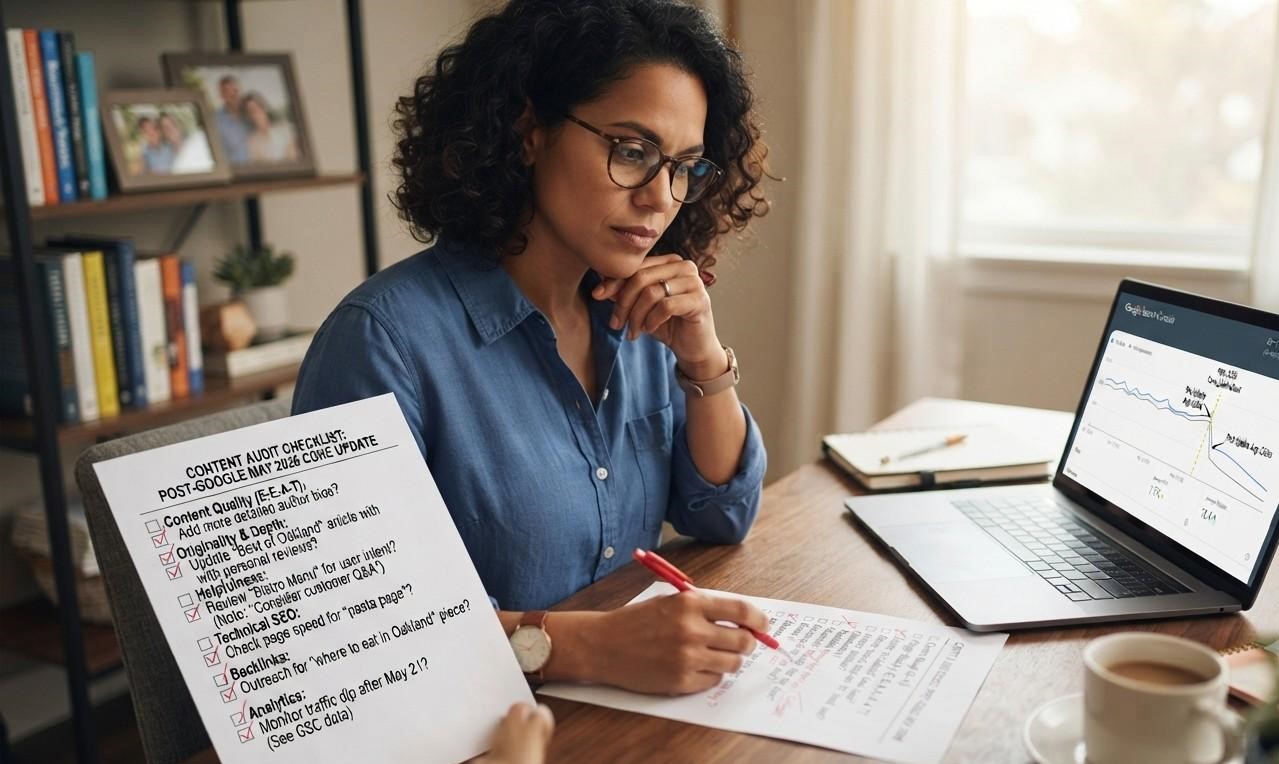
Quick answer –The Google May 2026 update rolled out from May 21 to June 2. It rewarded original, non-commodity content over generic listicles. That is how the Google May 2026 update affects small business marketing in plain terms. Audit your top pages first.
Your blog traffic dropped twenty percent overnight and nothing on your site changed. That is the Google May 2026 update at work. It affects small business marketing more than any core update in two years. Restaurants and real estate teams felt it first. The update rewarded pages with real expertise. It punished generic listicles.
- The Google May 2026 update finished rolling out on June 2, 2026.
- Google rewarded original, first-hand content and demoted generic listicle pages.
- Six days earlier Google published its first official guide on AI search optimization.
- Wait one full week after a core update before judging the damage.
- This is exactly how the Google May 2026 update affects small business marketing strategy going forward.
What The Google May 2026 Update Means For Small Business Marketing
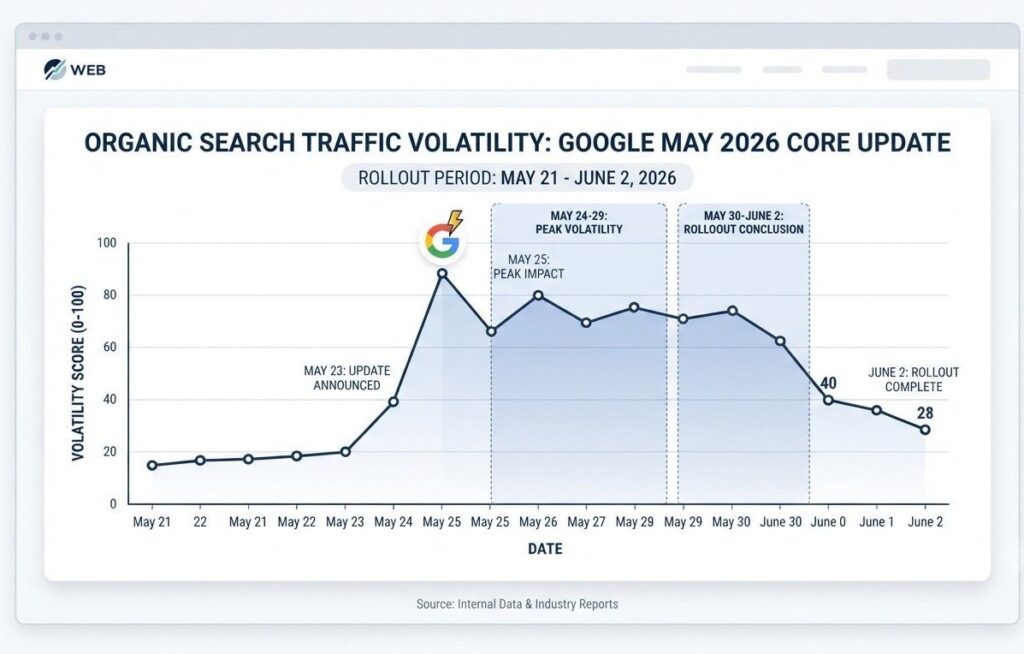
The Google May 2026 update rolled out in two stages. So it started on May 21 and finished on June 2, 2026.
That is twelve days from start to finish, according to Search Engine Land. Google called it a regular update. The goal was to surface relevant, satisfying content from all types of sites. This was Google’s second core update of the year. The first one landed in March 2026. Each core update re-scores the entire search index, so pages do not get penalized one by one. Instead, Google re-ranks everything against its quality model at once. That is why volatility hits fast and hits wide. For example, restaurant blogs, realtor sites and local service pages all felt movement within 48 hours. Some sites gained visibility, while others lost it overnight. Neither outcome means your page broke a rule. It simply means the quality bar moved, and your content sat on the wrong side of it. Google also confirmed that AI Mode passed one billion monthly users that same week. Search is shifting toward multi-step, conversational sessions now. Your content has to hold up across more than one type of query.
How To Tell If The Update Hit Your Site
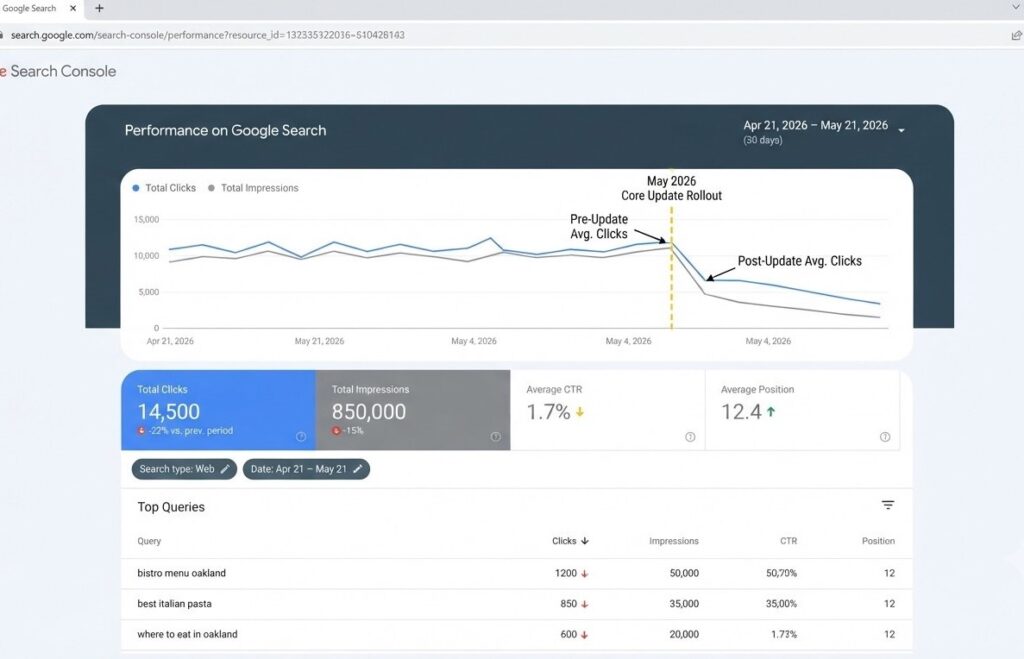
Open Google Search Console before you panic. Then compare last week’s clicks and impressions to the same week last month. These are the right signals to check after the Google May 2026 update hits your site. A small dip from position two to four needs no action. However, a steep drop across many pages tells a different story. Wait at least one full week after the rollout ends before you judge anything. Google’s own core update documentation recommends this exact waiting period, since rankings wobble during the rollout itself. So early data lies to you. Once the dust settles, pull eight weeks of data if you can. Look for a flat line that suddenly drops on a known date. That shape points to an algorithm event, not a slow content decline. A gradual downward slope, on the other hand, points to aging content or a stronger competitor. Check your most visited pages first, because they carry the clearest signal. Go beyond the homepage. Pull data for individual blog posts and service pages too. A core update can lift one page while it quietly drags down another on the same site.
The Content Type Google Rewarded This Time
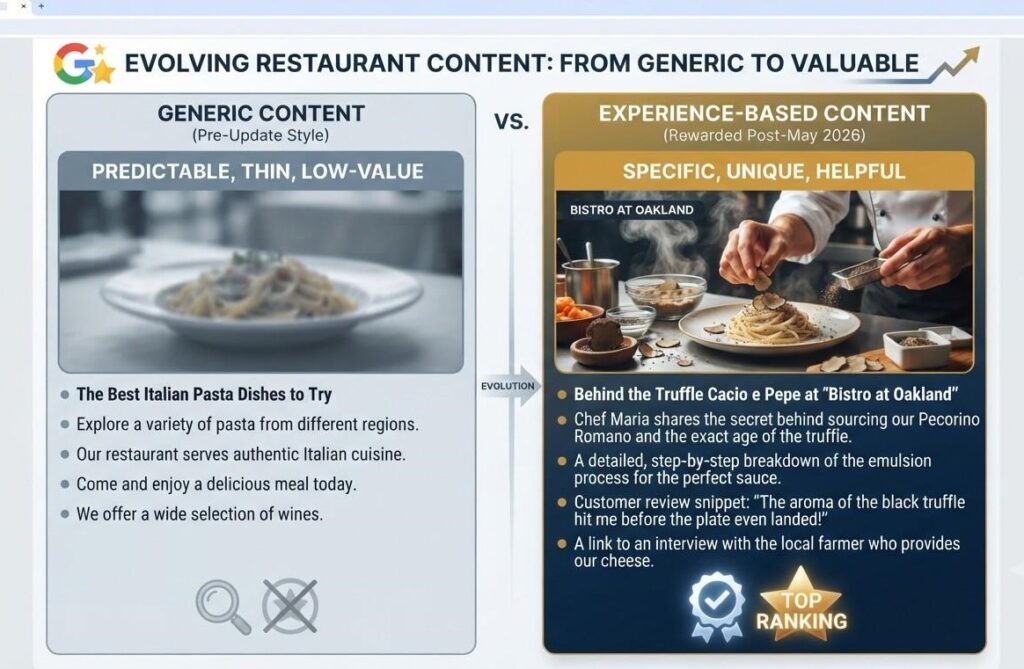
Six days earlier, Google published its first official guide on optimizing for generative AI search. The timing lines up with the Google May 2026 update. The timing was no accident. The guide drew a sharp line between commodity content and non-commodity content. For instance, a post titled Five Tips For First-Time Homebuyers is commodity content. Everyone has written that post already. A post about why you waived a home inspection and what it actually saved you is non-commodity content. Nobody else has that story. The May update rewarded pages built on real experience over pages built on research alone. That single shift explains most of the volatility agencies reported. As a result, generic round-ups lost ground. Meanwhile, first-hand case studies, named examples and specific numbers held steady or climbed. If your blog leans on broad advice with no specific story behind it, this update likely touched you. The fix is not more keywords. The fix is more proof that a real person did the thing they are writing about. Google’s guide also explains a concept called query fan-out. One search triggers several related queries behind the scenes. Your page does not need to chase every variation. It just needs enough real substance to surface across a few of them naturally.
Where Restaurants And Realtors Should Focus Now
Local business content took a particularly hard look in the Google May 2026 update this round. A restaurant post about general menu trends reads like commodity content to Google. On the other hand, a post about one specific dish change reads like proof. It increased weekend covers by eighteen percent. The same logic applies to real estate. A generic guide to staging a home is everywhere already. A specific breakdown of one listing stands out instead. Show the offers it got and the staging choice that worked. Plus, our restaurant marketing clients are seeing steadier rankings through this Google May 2026 update. They lean on real numbers from real campaigns. The same holds for real estate marketing clients who publish actual transaction stories instead of generic buyer tips. In short, local proof beats broad advice every time now. Photos of your actual storefront, listing or team also carry more weight now. Stock imagery no longer cuts it. Specificity is the entire strategy here. The same applies to your Google Business Profile. Fresh, real photos of your dining room or your latest listing tend to win now. They outperform polished stock shots in local results, especially after this update.
Should You Change Your SEO Strategy After A Core Update
Not all at once, and not in a panic. This is where the Google May 2026 update affects small business marketing strategy the most. It punishes overreaction. Google has said for years that pages performing well should stay untouched after a core update. Ripping out content because of one bad week usually makes things worse. Instead, audit calmly. First, find your pages that dropped the most. Then ask whether they read like commodity content or non-commodity content. If they read generic, rewrite them with a real example, a named client or a specific result. Our SEO, GEO and AEO services start with this exact audit. Preset templates cannot fix a quality problem. Also skip quick fixes like deleting random sections or stuffing in extra keywords. Those moves chase symptoms, not the actual cause. The smarter move is a content review every quarter, timed loosely around Google’s update calendar. Google has also rolled out a Preferred Sources feature. It lets searchers choose which sites they want to see more often. Encouraging loyal readers to select your site there is a small step that compounds over time.
How To Recover Lost Rankings After A Core Update
Recovery is rarely instant, and Google has been honest about that. There is no specific fix that guarantees a bounce back. Most sites that recover do so gradually, often after the next core update confirms the improvement. That does not mean you wait and do nothing, though. Rewrite your weakest pages now, while the lesson from the Google May 2026 update is fresh. Add real detail, real photos and a real point of view to anything that reads generic. Also check technical basics: broken links, slow pages and duplicate content still matter. Besides, review our generative engine optimization guide if AI Overviews and AI Mode visibility matter to your business. Track your top pages weekly instead of checking once and forgetting about it. As a result, small improvements compound across every future core update, not just this one. Patience plus real content work beats any quick trick Google has ever penalized. Keep a simple log of every page you rewrite and the date you changed it. That log becomes priceless evidence the next time a core update rolls through. You will know exactly what moved the needle.
Ready For A Strategy Built On Real Proof?
The Google May 2026 update affects small business marketing by rewarding real proof over generic advice. Our SEO, GEO and AEO services start with a full audit before we write a single word. So book a free audit through our contact page and find out exactly where your content stands today.
Frequently asked questions
What changed in the May 2026 Google core update?
The Google May 2026 update rolled out from May 21 to June 2. It re-scored Google’s index against its quality model. So it rewarded original, first-hand content and pushed down generic, recycled advice. This is the clearest version yet of how the Google May 2026 update affects small business marketing. Experience now outranks volume. Sites built on real stories gained visibility, while sites built on broad tips lost it.
How do I know if my website was affected by the update?
Open Search Console and compare your clicks from last week against the same week one month ago. Wait a full week after the rollout ends before drawing conclusions, since mid-rollout data shifts constantly. A small drop, like position two to four, needs no action at all. However, a steep, sitewide decline across many pages signals real impact and deserves a closer review.
What type of content did Google reward in the May update?
Google rewarded non-commodity content: posts built on first-hand experience, specific numbers and a genuine point of view. Generic round-ups and broad tip lists lost ground, because dozens of other sites already say the same thing. For example, a restaurant post about one menu change beats a list of common trends. It shows the exact result. Specific beats generic now.
Should I change my SEO strategy after the May 2026 update?
Yes, but slowly and calmly, never in a panic. The Google May 2026 update affects small business marketing strategy by rewarding patience over quick fixes. So audit your weakest pages, find the generic ones and rewrite them with real examples and named results. Skip deleting whole sections or stuffing extra keywords, since neither move addresses the actual quality gap Google flagged.
What is non-commodity content and why does Google prefer it?
Non-commodity content is writing built on direct experience that nobody else can copy. Think a specific result, a named client or a personal story. Commodity content, on the other hand, repeats common knowledge that hundreds of other pages already cover. Google prefers non-commodity content because it actually helps the reader learn something new. It is not recycling the same five tips every competitor already published.
How do I recover rankings after a core update?
Recovery usually takes time after the Google May 2026 update. It often lines up with the next core update confirming your improvements. That waiting period is part of how the Google May 2026 update affects small business marketing planning today. So start by rewriting your weakest, most generic pages with real detail and a clear point of view. Fix technical basics like broken links and slow load times along the way too.