Quick summary —You spend money on marketing every month but have no idea if it works. Knowing how to measure digital marketing roi for local business tells you exactly which channels earn more than they cost and which ones quietly drain your budget. That knowledge changes every decision you make from this point forward.
ROI in digital marketing means revenue earned divided by money spent, times 100.
- Different channels take different amounts of time to show results — know the timeline.
- Five numbers tell you everything: traffic, leads, cost per lead, conversion rate and revenue.
- Google Ads shows ROI in weeks. SEO shows ROI in months. Both compound over time.
- Restaurants and realtors need different KPIs because their sales cycles work differently.
Why most local businesses measure the wrong things and miss the real picture
Most restaurant owners check Instagram likes. Most realtors watch their follower count. Both numbers feel good when they go up. But neither one tells you whether your marketing makes money. Likes do not pay your rent. Followers do not close deals.
Knowing how to measure digital marketing roi for local business starts with ignoring vanity metrics entirely. A restaurant post with 400 likes but zero new reservations from it produced no ROI. A post with 12 likes that prompted 8 people to book a table produced excellent ROI. The second post wins every time even though it looks less impressive on the surface.
So the first shift you make is from activity metrics to outcome metrics. Activity metrics count what you did. Outcome metrics count what happened as a result. Outcome metrics are the only ones worth tracking consistently every single week.
According to HubSpot’s marketing ROI research [opens in new tab], 40% of small businesses say they cannot measure the ROI of their marketing at all. That gap represents money leaving the business with no accountability attached. Closing that gap is one of the most direct ways to improve your results without spending more.
How to measure digital marketing ROI for local business using five core numbers
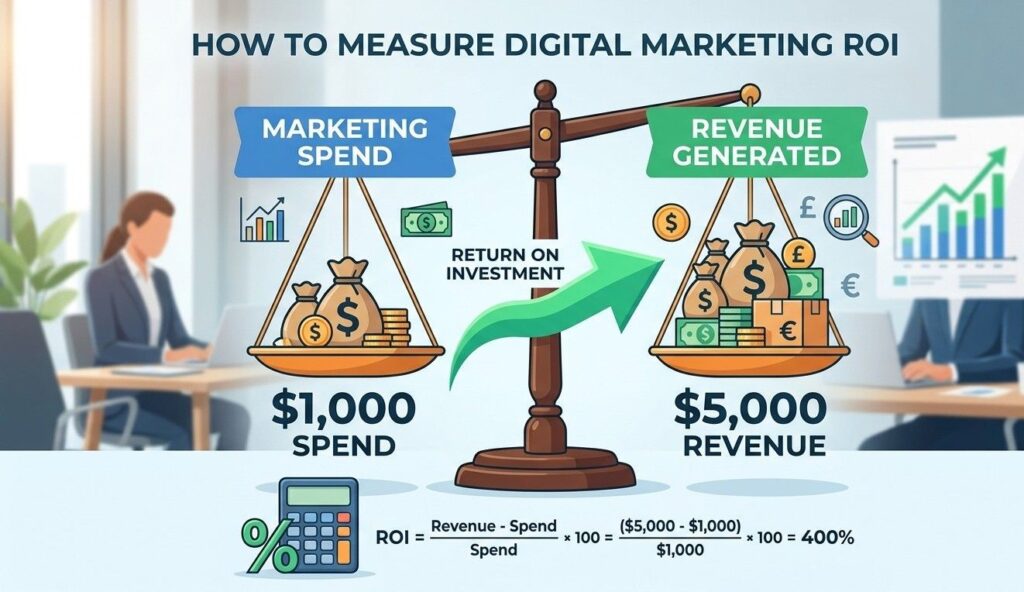
The formula for how to measure digital marketing roi for local business looks like this. Take the revenue a channel generated. Subtract what you spent on that channel. Divide the result by what you spent. Multiply by 100. That gives you your ROI as a percentage.
So if you spend $500 on Google Ads and those ads bring in $2,000 in new restaurant bookings, your ROI is 300%. If you spend $500 on social media management and it brings in $400 in new business, your ROI is negative 20%. Both numbers are useful. Both tell you what to do next.
The five KPIs every local business tracks every single week
First, track website traffic. How many people visited your site and from which source? Google Analytics gives you this for free. Second, track leads generated. How many people called you, filled a form or booked a table directly from digital channels?
Third, track cost per lead. Divide your monthly marketing spend by the number of leads it produced. Fourth, track your conversion rate. Of every 10 leads, how many became paying customers? Fifth, track revenue from marketing. Ask every new customer how they found you. A simple question at the point of sale or booking gives you real attribution without any software.
These five digital marketing kpis for restaurants and realtors apply to both niches but in slightly different ways. A restaurant measures table bookings and average spend. A realtor measures consultations booked and commissions closed.
Digital marketing results timeline small business: when to expect what from each channel
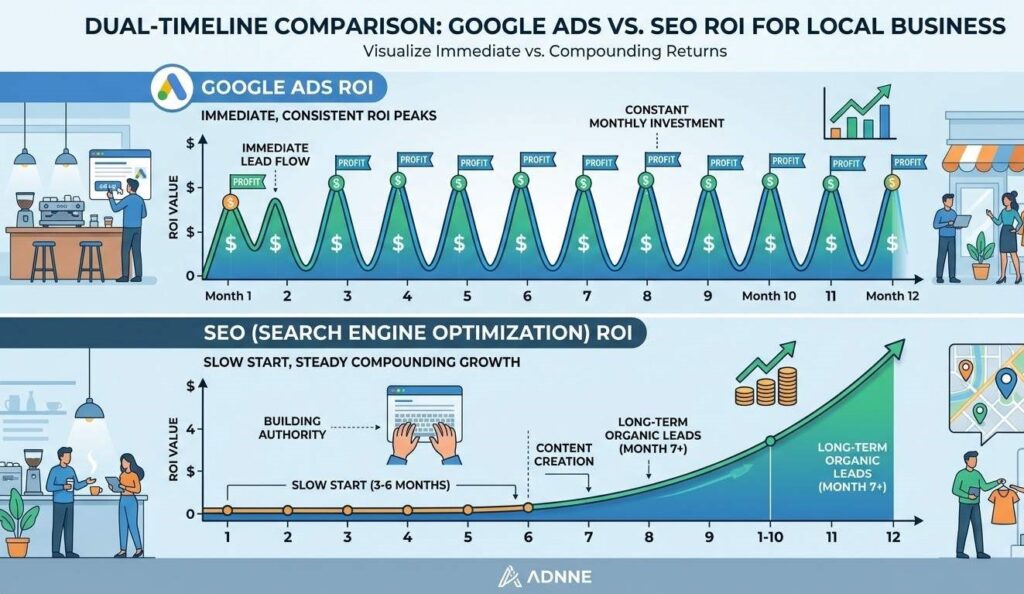
The digital marketing results timeline small business owners miss most often is the one that separates fast channels from slow ones. Mixing up those timelines causes people to quit channels that were about to pay off and overspend on channels that already peaked.
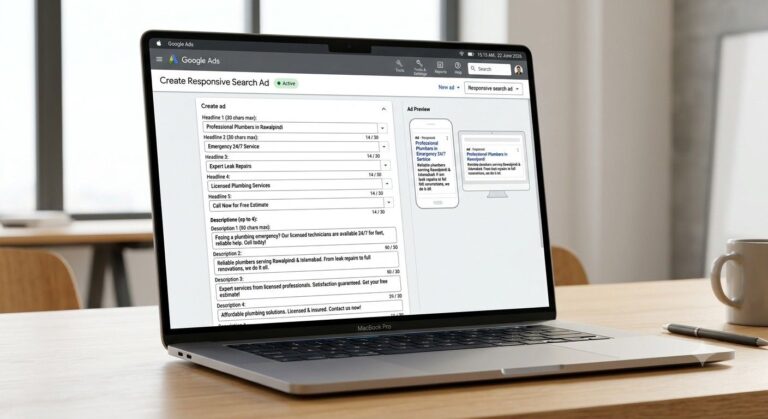
Google Ads produces leads in the first 7 to 14 days of a live campaign. That speed makes it the right choice when you need immediate results. But Google Ads stops the moment you pause it. So it builds no lasting asset in your business.
How long does SEO take to show results for a local business
How long does seo take to show results depends on your starting position. A brand-new website with no content and no backlinks typically takes 3 to 6 months to appear on page one for low-competition keywords. A site with existing authority can rank new content in 4 to 8 weeks.
But here is what makes SEO worth the wait. A blog post that reaches page one keeps sending you traffic and leads every month without any extra spend. Our post on the local SEO checklist for small business owners covers the specific steps that accelerate that timeline.
Social media shows early engagement in 4 to 6 weeks with consistent posting. But social media converts to real leads most reliably after 3 to 6 months of consistent presence. That compound effect is why businesses that quit after 30 days always miss the window where social really pays.
Digital marketing KPIs for restaurants and realtors: what each niche tracks differently
Digital marketing kpis for restaurants and realtors share the same core logic but measure different outcomes. And here is why that matters. A restaurant’s average transaction is $40 to $80. A realtor’s average commission is $6,000 to $15,000. That gap changes which cost per lead is acceptable and which timeline makes sense.
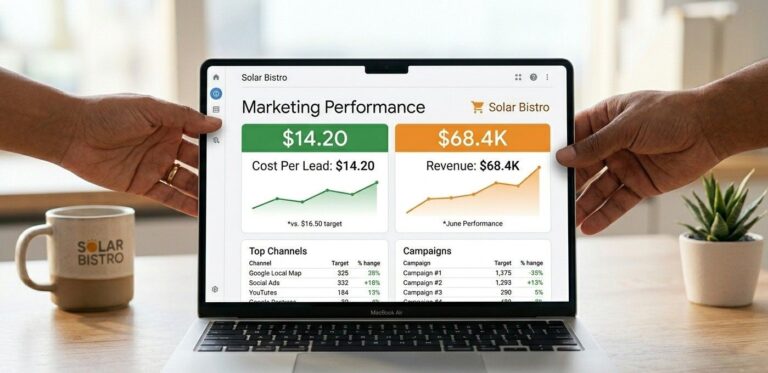
For restaurants, track new covers per month from digital channels, cost per reservation and repeat visit rate from customers who found you online. A restaurant spending $600 per month on marketing and generating 80 new covers at $55 average spend earns $4,400 from a $600 investment. That is a strong result worth scaling.
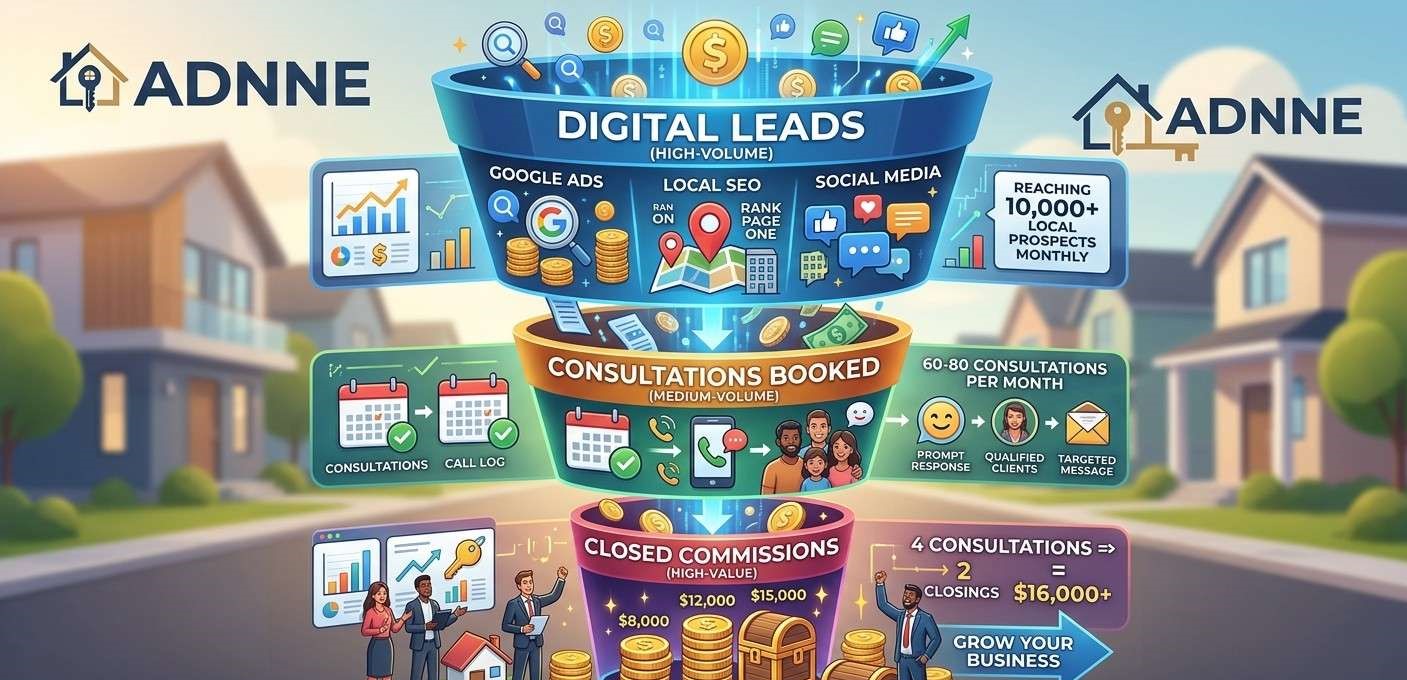
For realtors, track consultations booked per month, cost per consultation and close rate from digital leads. A realtor spending $1,000 per month on Google Ads and booking four consultations at a 50% close rate earns two new commissions. If each commission averages $8,000, that $1,000 investment returns $16,000. That math makes the spend an easy decision.
Our lead generation service for realtors tracks all of these numbers for every client and reports them monthly in plain language. No confusing dashboards. Just the five numbers that tell the whole story.
Which digital marketing channel produces the best ROI for local businesses right now
The honest answer is: it depends on your niche, your budget and your timeline. But patterns do emerge when you look across enough local businesses to see clear trends.
Google Ads consistently delivers the fastest ROI for both restaurants and realtors when the campaign uses tight local targeting and a focused landing page. Our post on Google Ads for restaurants covers the exact setup that produces those results for food businesses.
SEO delivers the best long-term ROI because it keeps working without ongoing spend. A page that ranks on Google and brings in 20 leads per month costs nothing to maintain after the initial work. Over 12 months, that single page can produce more ROI than a year of paid ads on the same budget.
Social media delivers the strongest brand awareness ROI, especially for businesses with a visual product like restaurants. Sprout Social’s 2025 ROI report [opens in new tab] found that 68% of businesses report social media contributes to revenue indirectly through increased brand trust. That trust lowers your cost per lead across every other channel you run at the same time.
According to Search Engine Journal’s digital marketing benchmark data [opens in new tab], SEO produces the highest ROI over a 12-month period compared to paid search and social media combined. The catch is that it needs 3 to 6 months of consistent effort before that return shows up clearly in your numbers.
You do not need a complex dashboard to know whether your marketing pays off. You need five numbers tracked consistently each week. Start with how to measure digital marketing roi for local business on your highest-spend channel first and build from there. And if you want a team that reports your results in plain language every single month, our full-service marketing team is ready to talk.
Frequently Asked Questions
Q: How do I measure the ROI of digital marketing?
Take the revenue your marketing generated, subtract what you spent and divide that result by your spend. Then multiply by 100 to get a percentage. If you spent $500 and earned $1,500 in new business, your ROI is 200%. Track this number separately for every channel you run. How to measure digital marketing roi for local business gets clear fast once you assign revenue to each specific source.
Q: How long does it take to see digital marketing results?
It depends on the channel. Google Ads shows results in 7 to 14 days. Social media builds real lead flow in 2 to 3 months. SEO takes 3 to 6 months for meaningful traffic. Local SEO improvements on your Google Business Profile show up in 4 to 8 weeks. The digital marketing results timeline small business owners need to plan around is: paid channels are fast and stop when you pause, organic channels are slow and keep working after you stop spending.
Q: What is a good ROI for digital marketing?
A 200% to 500% ROI is considered strong for most local businesses on paid channels. That means earning $2 to $5 for every $1 spent on ads. On SEO and content marketing, the ROI runs much higher over 12 months because the ongoing cost drops once content ranks. A restaurant or realtor hitting 300% ROI consistently across their paid channels should scale up that spend before changing anything about the campaign.
Q: Which digital marketing channel has the best ROI for local businesses?
SEO produces the best long-term ROI. Google Ads produces the best short-term ROI. Social media produces the best brand awareness ROI. The right answer depends on your timeline. If you need leads this month, run Google Ads. If you want to build a lead asset that pays for years, invest in SEO and content. Most successful local businesses run Google Ads for speed and SEO for compounding long-term returns at the same time.
Q: How do I track leads from digital marketing?
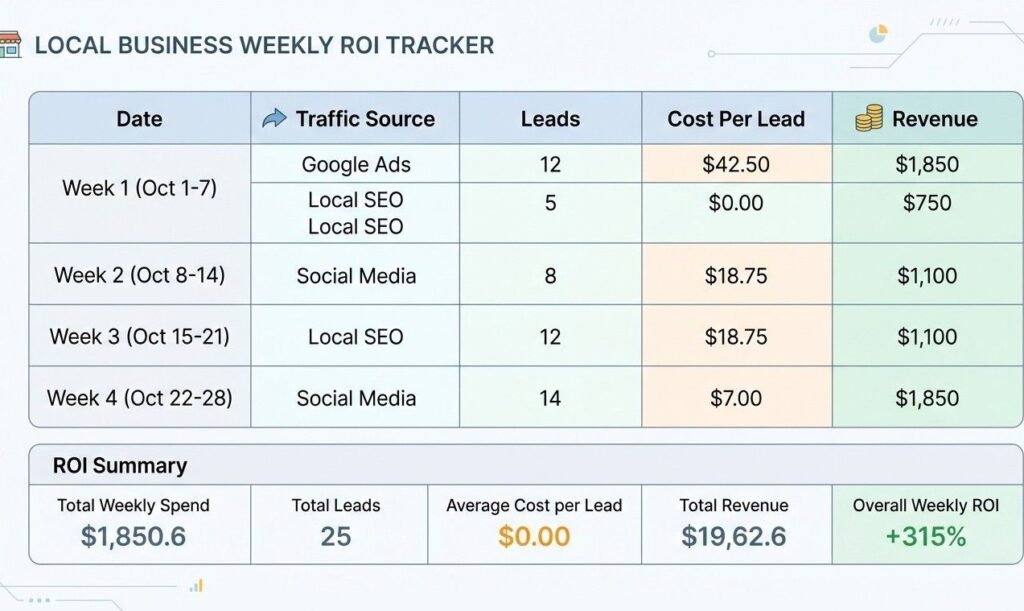
Ask every new customer how they found you at the point of booking or sale. Set up Google Analytics to track traffic sources and form fills. Set up conversion tracking in Google Ads so every phone call and form fill gets attributed to a specific campaign. Use a simple spreadsheet to log new leads by source each week. Those four steps give you enough data to make smart budget decisions without any expensive software.
Q: When should I fire my digital marketing agency?
Fire your agency if they cannot explain exactly what they did each month and what results it produced. Fire them if your cost per lead keeps rising without a clear reason. Fire them if they report on vanity metrics like followers and impressions instead of leads and revenue. But give any new agency at least 90 days before judging results. How to measure digital marketing roi for local business gives you the data to make that call clearly rather than based on gut feeling.
Q: Do I need expensive software to track my digital marketing ROI?
No. Google Analytics is free and tracks your website traffic and conversions. Google Ads has built-in conversion tracking at no extra cost. A simple spreadsheet with five columns covers the rest: channel, spend, leads generated, cost per lead and revenue attributed. Most local businesses get everything they need from free tools in the first 90 days. Paid attribution tools become useful later when you run five or more channels at once and need automated reporting.