Quick answer — Learning how to write Google Ads copy that converts for local businesses comes down to three things: lead with a specific benefit instead of a generic claim, include your primary keyword in at least three headlines, and match every ad’s promise to the exact landing page a click lands on. According to WordStream’s 2026 Google Ads Benchmarks, the average conversion rate across 13,474 campaigns is 8.18%, and copy that speaks directly to local intent consistently beats that average.
Most Google Ads for local businesses say the same thing: “Quality Service. Call Today.” That copy is invisible because every competitor writes it too. Knowing how to write Google Ads copy that converts for local business starts with one shift: stop describing your business and start naming the exact result a specific customer wants right now.
- How to write google ads copy that converts local business comes down to specificity: name the exact outcome, location and timeframe instead of generic claims.
- Use at least 10 of the 15 available headline slots in a Responsive Search Ad and include your keyword in at least three of them.
- WordStream’s 2025 account study found the average Google Ads Quality Score sits at just 5 to 6 out of 10, meaning most local advertisers are leaving easy wins on the table.
- Mix logical proof points (price, hours, guarantee) with one emotional headline that names the customer’s actual frustration or goal.
- Every word in your description should earn its place. Cut filler words like ‘amazing’ and ‘best’ that Google’s own data shows do not move click-through rate.

What Makes a Good Google Ads Headline for a Local Business
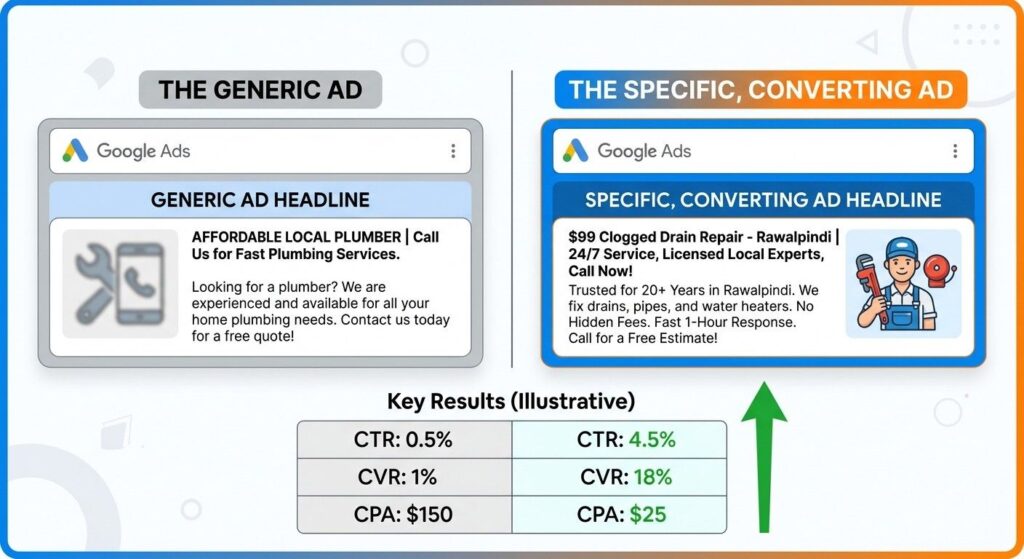
A strong local headline does three things in 30 characters or less. It names the service, it signals proximity or urgency, and it gives the searcher a reason to click this ad instead of the one above or below it. Generic headlines like “Best Plumber in Town” fail all three tests because every competitor claims the same thing.
Compare these two headlines for a local plumber. Before: “Quality Plumbing Services.” After: “Same-Day Drain Repair, Austin.” The second version names the specific service, includes a timeframe and a location, all within the 30-character limit that Google Ads Help confirms applies to every Responsive Search Ad headline. The first version could belong to any plumbing business in the country.
Write headlines that work alone and in combination, since Google’s system mixes and matches them automatically. A headline that only makes sense next to a specific other headline will fail when shown in a different combination. Test each headline as a standalone idea: does it make sense if a searcher only sees this one line and nothing else?
How Many Headlines Should a Google Ads Campaign Have?
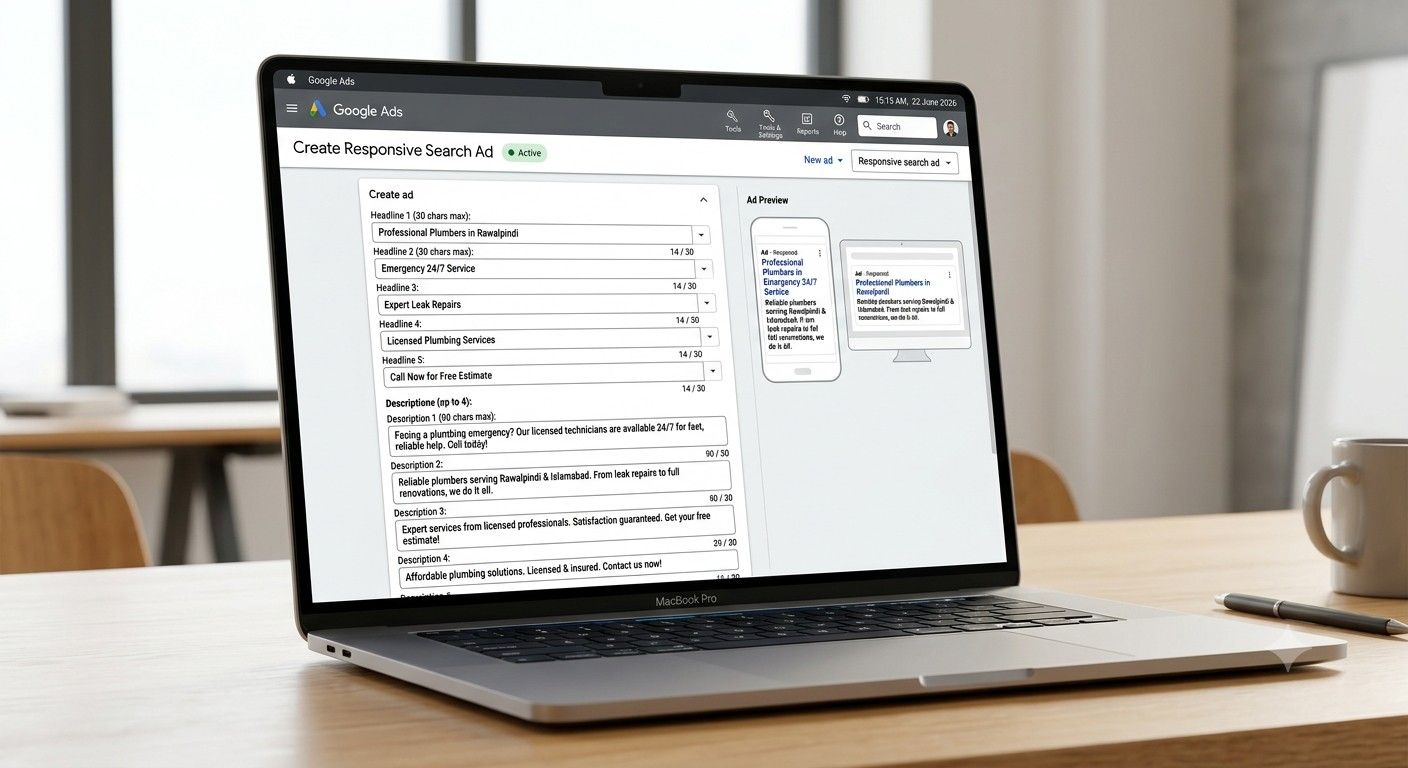
Google allows up to 15 headlines and 4 descriptions per Responsive Search Ad, but most local advertisers stop at 3 or 4. That is a mistake. Google Ads Help’s own internal data shows advertisers who improve their Ad Strength from “Poor” to “Excellent” see 15% more clicks and conversions on average, and headline count is one of the biggest drivers of that score.
Aim for 10 to 12 unique headlines per ad. Spread them across three categories: keyword-focused (naming the service and location), benefit-focused (the specific outcome, like “Fixed in 60 Minutes”) and trust-focused (a guarantee, certification or years in business). This spread gives Google’s machine learning enough variety to match different search intents without repeating the same idea in slightly different words, which actually hurts your Ad Strength score rather than helping it.
Write each headline so it could appear next to any other headline in your list and still make sense. Google shows two to three headlines together at a time, in whatever order it determines performs best, so headlines written as a dependent sequence will often display in a confusing order.
What Is a Good Google Ads Quality Score for a Local Business?
Understanding the Three Components
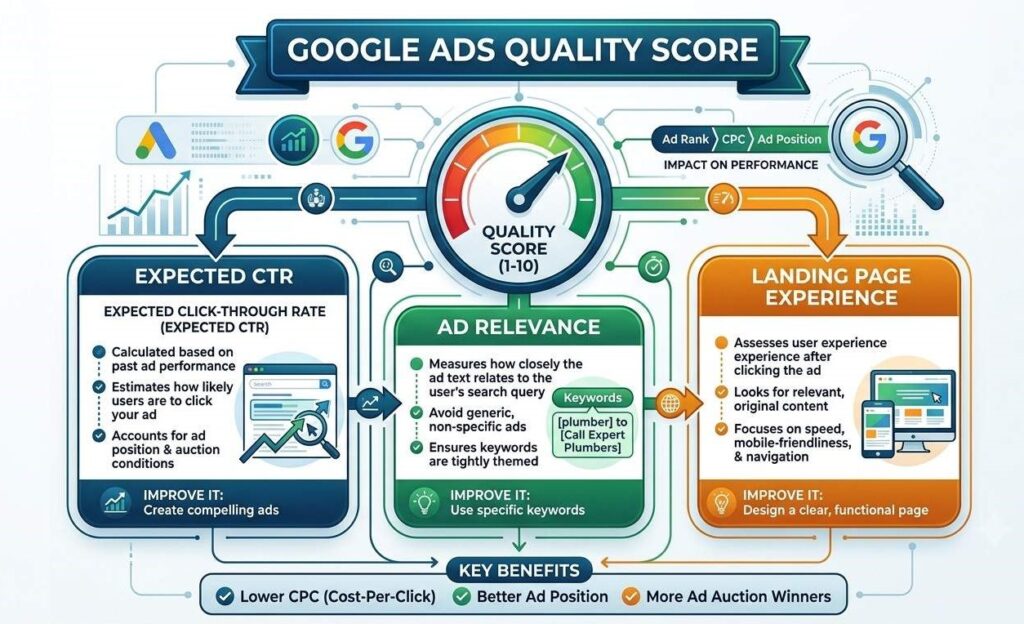
Quality Score runs from 1 to 10 and is built from three pieces: expected click-through rate, ad relevance and landing page experience. According to WordStream’s 2025 analysis of 15,666 Google Ads accounts, the average Quality Score sits at just 5 to 6, which means a score of 7 already puts a local business ahead of most competitors in the same auction.
Why Your Copy Affects All Three Components
Your ad copy directly drives two of the three Quality Score components. Ad relevance improves when your headlines closely match the keywords you bid on. Expected CTR improves when your copy is specific enough that the right searchers click and the wrong ones do not. A higher Quality Score lowers your cost per click, since Google rewards relevant, clickable ads with cheaper placement in the auction.
Should I Use Emotional or Logical Copy in Google Ads?
Use both, but in different headline slots. Logical copy proves you are a safe choice: price, hours, certifications, guarantees. Emotional copy names the feeling behind the search: relief, urgency, frustration. A homeowner searching for “emergency plumber near me” is not just looking for a service, they are stressed about water damage spreading through their house right now.
A practical mix for a local business with 10 headlines: 4 logical (price, hours, guarantee, certification), 4 keyword-and-location focused, and 2 purely emotional (naming the customer’s frustration or relief directly). Restaurant example: logical headline “Open Until 11pm Tonight,” emotional headline “Stop Wondering Where to Eat.” Both speak to the same searcher from different angles. For restaurants specifically, our Google Ads management service for restaurants builds exactly this kind of mixed headline structure into every campaign.
How to Write a Google Ads Description That Gets Clicks
Descriptions give you 90 characters, twice the length of a headline, which is enough room to expand on one specific benefit rather than restating your headline. The mistake most local businesses make is using the description to repeat the headline in different words instead of adding new information.
Write each of your four available descriptions to highlight a different angle: one on pricing, one on speed or availability, one on social proof (review count, years in business), and one on a clear call to action. WordStream’s research on responsive search ads consistently shows that ads with diverse, non-redundant description content outperform ads where every description says roughly the same thing in different words.
End at least one description with a direct call to action that matches your landing page’s actual next step, whether that is “Book Online Now” or “Call for a Free Quote.” For realtors and other local business lead generation, that final line is often the difference between a click that bounces and a click that converts.
Write Ads That Actually Earn the Click
How to write google ads copy that converts local business comes down to specificity over generic claims, and a clear mix of logical and emotional headlines built to Google’s actual format limits. If you want help building campaigns with copy structured this way from day one, our Google Ads management team at Adnnel handles the full setup. Reach out today and we will review your current ad copy at no cost.
Written by Wajahat
Frequently asked questions
What makes a good Google Ads headline for a local business?
A good local headline is specific, not generic. It names the exact service, includes a location or timeframe, and avoids vague claims like ‘best’ or ‘quality’ that every competitor also uses. Headlines must work as standalone ideas since Google mixes and matches them in different combinations. Learning how to write google ads copy that converts local business starts with replacing broad claims with concrete, specific details.
How many headlines should a Google Ads campaign have?
Use 10 to 12 of the 15 available headline slots. Google Ads Help’s own data shows advertisers who go from ‘Poor’ to ‘Excellent’ Ad Strength see 15% more clicks and conversions on average, and headline count drives a large part of that score. Spread your headlines across keyword-focused, benefit-focused and trust-focused angles so Google’s system has real variety to test.
What is a good Google Ads quality score?
A score of 7 or higher is considered strong, since WordStream’s 2025 study of 15,666 accounts found the average Quality Score across all advertisers sits at just 5 to 6. Quality Score is built from expected click-through rate, ad relevance and landing page experience, and your ad copy directly influences two of those three components. A higher score typically lowers your cost per click.
Should I use emotional or logical copy in Google Ads?
Use a mix of both rather than choosing one. Logical copy, like price, hours and guarantees, proves you are a safe choice. Emotional copy names the actual feeling behind the search, like urgency or relief. A balanced set of 10 headlines might include 4 logical, 4 keyword-focused and 2 purely emotional angles, giving Google’s system enough variety to match different searcher mindsets.
How do I write a Google Ads description that gets clicks?
Use each of your four descriptions to highlight a different angle instead of restating your headline. Cover pricing, speed or availability, social proof and a direct call to action across your four slots. Descriptions that simply repeat headline content in different words waste valuable character space. How to write google ads copy that converts local business depends heavily on giving each description a distinct, non-redundant job to do.
What words should I avoid in Google Ads copy?
Avoid vague superlatives like ‘best,’ ‘amazing’ and ‘quality’ that carry no specific information and that every competitor also uses. These words do nothing to differentiate your ad and waste limited character space that could hold a real detail like a price, a timeframe or a guarantee. Specific, concrete language consistently outperforms generic praise in both click-through rate and conversion rate.