Quick answer — Restaurant website design tips that drive more reservations center on three things: a reservation system built directly into your site, mobile speed under three seconds, and a menu page that loads without forcing a PDF download. According to Toast’s 2025 diner survey, 65% of diners go directly to a restaurant’s website to book, rather than using a third-party app, which means your own site carries most of the booking weight.
A hungry customer finds your restaurant on Google, taps your website and waits. And waits. By the time your homepage finishes loading, they have already tapped back and picked somewhere else. Restaurant website design tips drive more reservations only if the site actually works on a phone, in a hurry, for someone deciding where to eat tonight.
- Restaurant website design tips drive more reservations when the site loads fast, works on mobile and lets guests book without leaving the page.
- Toast’s 2025 survey found 65% of diners book directly through a restaurant’s own website rather than a third-party app, so your site needs its own reservation tool.
- Mobile traffic now makes up over 62% of all web visits, so a site that only looks good on desktop is failing the majority of visitors.
- Every restaurant website needs five non-negotiable elements: hours, menu, location, online reservations and high-quality food photography.
- A slow site does not just lose visitors. It also hurts your local SEO rankings, since Google now weighs page speed heavily in mobile search results.
What Should Every Restaurant Website Include
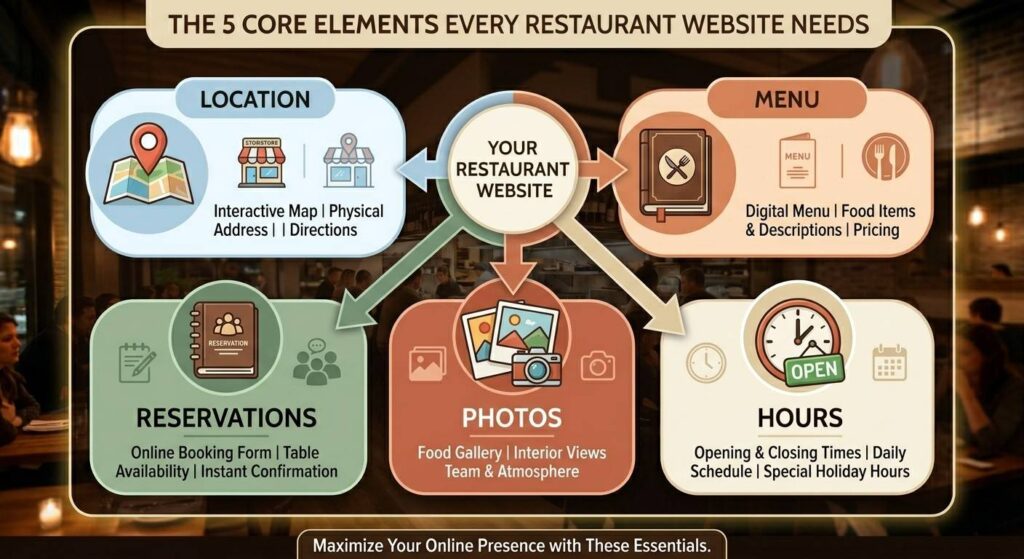
A restaurant website is a transactional tool, not a brochure. Every page should move a hungry visitor toward one of three actions: book a table, place an order or call. Five elements are non-negotiable and missing any one of them costs you reservations.
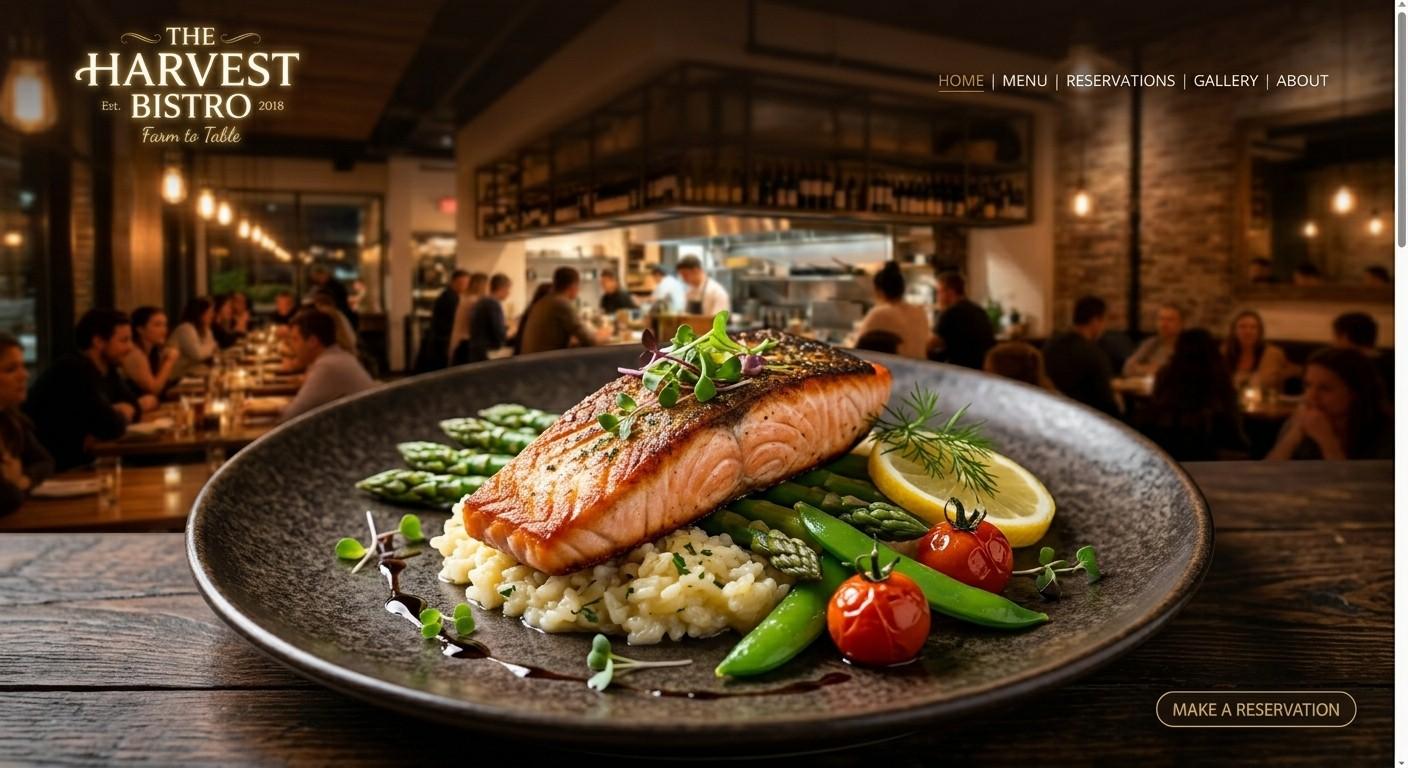
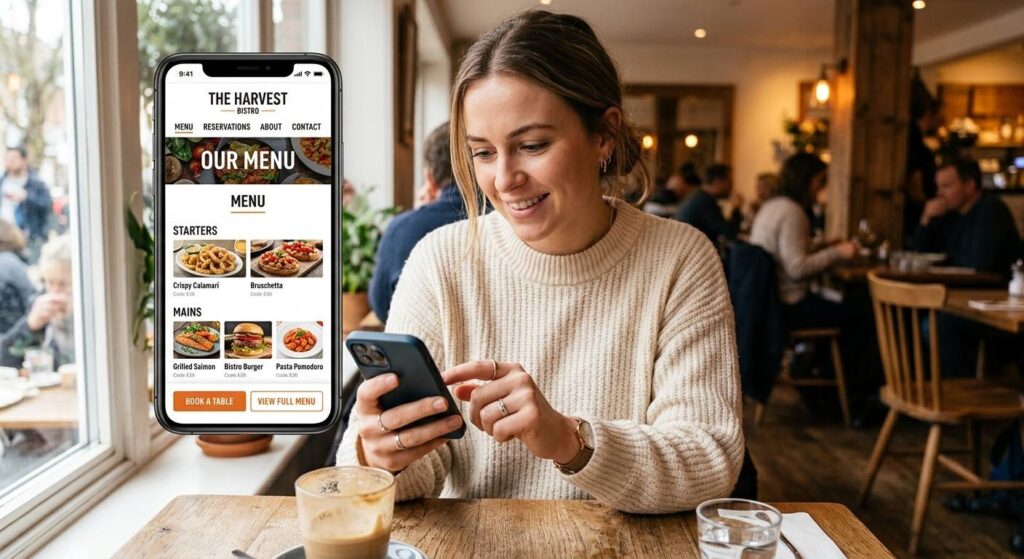
Hours and location need to be visible without scrolling, ideally in the header or a sticky bar that stays on screen. Your menu should load as an actual webpage, not a PDF that takes ten seconds to render on a phone. Online reservations need to live directly on your site, not buried behind a link to a third-party app. High-quality food photography, even just five to eight strong images, does more to convert a hesitant visitor than any amount of descriptive text.
The fifth element is often overlooked: a clear, single call to action above the fold. Many restaurant sites split attention between five different buttons. Pick one primary action, usually “Reserve a Table” or “Order Online,” and make it the most visible element on the page. This focus alone can meaningfully lift conversion, an approach our restaurant marketing team builds into every new site we design.
How to Add Online Reservations to Your Restaurant Website
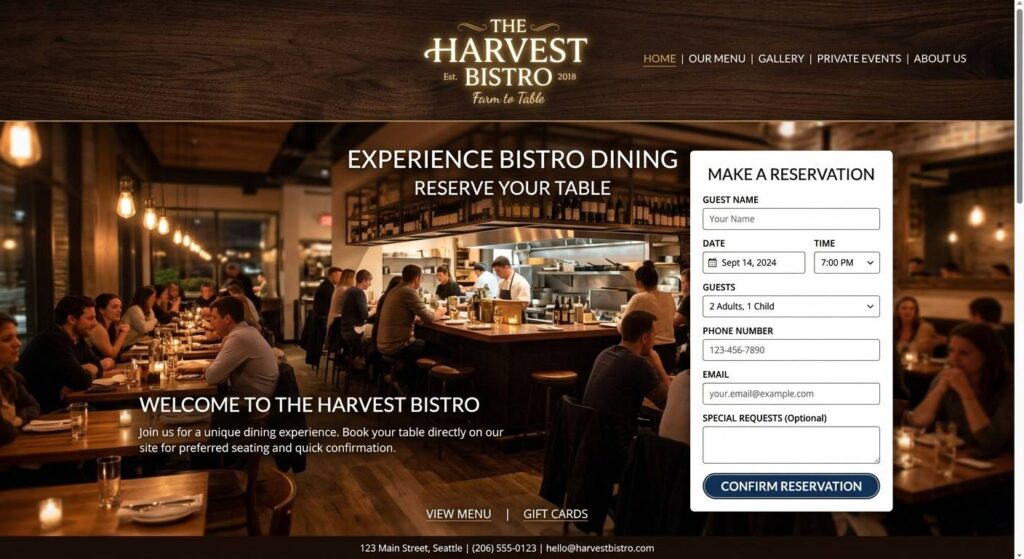
Adding a reservation system to your site is not optional in 2026. Toast’s 2025 survey of US diners found 65% go directly to a restaurant’s website to book, rather than searching a third-party platform first. If your site only has a phone number and a link out to OpenTable, you are sending two thirds of your booking traffic somewhere else before they even commit.
The simplest fix is embedding your reservation widget, whether that is OpenTable, Resy or Toast Tables, directly on your homepage and contact page rather than linking out. An embedded widget keeps the guest on your branded site through the entire booking flow, which builds trust and reduces the chance they abandon the process partway through.
If you already run your point of sale through Toast, Toast Tables connects reservation data straight into the same system your staff uses for service, which cuts down on double-bookings and missed updates. Whatever platform you choose, test the booking flow yourself on a phone, since a clunky mobile booking form is one of the fastest ways to lose a reservation you already had.
Does My Restaurant Website Need to Be Mobile-Friendly
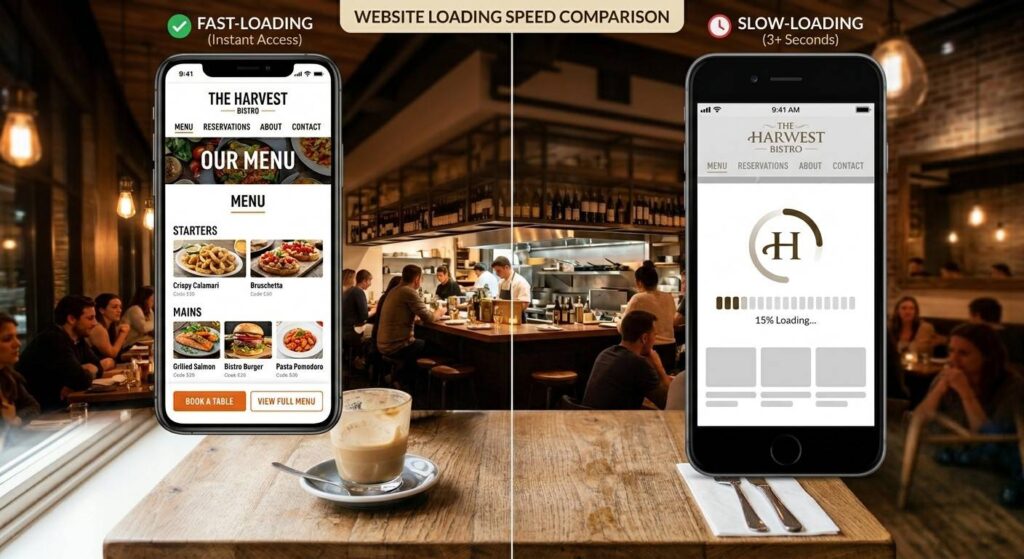
Yes, and the data leaves no room for debate. DigitalApplied’s 2026 page speed research shows mobile traffic now exceeds 62% of all web visits, yet only 42% of mobile sites pass all three of Google’s Core Web Vitals tests. For a restaurant, that gap is not abstract. It is the difference between a hungry person finding your menu in three seconds or giving up and choosing the next search result.
Mobile-friendly means more than the page resizing correctly. Buttons need to be large enough to tap accurately with a thumb. Your menu needs to be readable without pinching to zoom. Your reservation form needs fields sized for a phone keyboard, not a desktop mouse. A site that technically works on mobile but feels clunky still loses bookings, even if it passes a basic responsive design check.
How Website Design Affects Restaurant SEO
Page Speed Is a Direct Ranking Factor
Google has confirmed page speed as a ranking signal since 2010, and Google’s own search documentation continues to weight Core Web Vitals as part of the broader page experience signal. A slow restaurant site does not just frustrate visitors. It actively ranks lower in local search results, which means fewer people ever see it in the first place.
Structure and Content Affect Local Visibility
Beyond speed, the actual content structure on your site matters for local SEO. Building strong SEO for restaurant websites starts with clear page structure—naming your cuisine, neighborhood, and specialties gives Google and AI search tools more to work with when matching your restaurant to a relevant search. For a deeper breakdown of how that structure should look, our SEO and GEO optimization service covers exactly how restaurant pages should be built to rank.
Should a Restaurant Use a Website Builder or Hire an Agency
A DIY website builder like Squarespace or Wix can work for a brand-new restaurant testing the waters with a tight budget. These platforms handle hosting, basic mobile responsiveness and simple page layouts without requiring technical skills. The tradeoff is limited customization and generic templates that look similar across thousands of other small businesses.
While you might wonder what a digital marketing agency does for small businesses, an agency-built site specifically makes sense once reservations and online ordering become core revenue channels rather than nice-to-haves. A custom build can integrate your specific reservation system, optimize for the page speed benchmarks search engines reward and structure content for local SEO from day one rather than retrofitting it later. For a restaurant relying on consistent booking volume, that difference compounds month over month. Effective restaurant lead generation relies on a high-performing site that teaches you how to fill tables without discounting, as a slow or poorly structured site undermines every other marketing channel feeding traffic to it.
How to Make Your Restaurant Website Load Faster
Three fixes produce the fastest results for most restaurant sites. First, compress every image before uploading, since unoptimized food photography is the single biggest cause of slow load times on restaurant sites specifically. Second, remove any auto-playing background video on your homepage, since these are heavy files that delay everything else on the page from rendering.
Third, choose hosting built for speed rather than the cheapest available plan. A slow shared hosting server can add seconds to load time regardless of how optimized your actual page content is. Run your site through Google’s PageSpeed Insights tool to see exactly which of these three areas is costing you the most time, then fix the highest-impact issue first rather than trying to optimize everything simultaneously.
Build a Website That Actually Books Tables
Restaurant website design tips drive more reservations only when speed, mobile usability and a built-in booking system all work together on the same site. If you want a site built around exactly these priorities from the ground up, our restaurant marketing team at Adnnel handles design, speed and SEO as one connected project. Reach out today and we will review your current site at no cost.
Written by Wajahat
Frequently asked questions
What should every restaurant website include?
Every restaurant website needs five core elements: visible hours and location, a menu that loads as a real webpage rather than a PDF, an embedded online reservation system, strong food photography and one clear primary call to action above the fold. Restaurant website design tips drive more reservations most effectively when these five elements work together instead of competing for the visitor’s attention.
How do I add online reservations to my restaurant website?
Embed your reservation platform’s widget, such as OpenTable, Resy or Toast Tables, directly into your homepage and contact page rather than linking out to an external site. Toast’s 2025 survey found 65% of diners prefer booking directly through a restaurant’s own website, so keeping the booking flow on your branded site builds more trust than redirecting elsewhere. Test the mobile booking experience yourself before launching it.
Does my restaurant website need to be mobile-friendly?
Yes. Mobile traffic now exceeds 62% of all web visits, and only 42% of mobile sites currently pass Google’s Core Web Vitals tests. A restaurant site that only works well on desktop is failing the majority of people searching for a place to eat. Mobile-friendly means large tappable buttons, readable text without zooming and a reservation form sized correctly for a phone screen.
How does website design affect restaurant SEO?
Page speed is a confirmed Google ranking factor, so a slow restaurant website ranks lower in local search results regardless of how good the food or service is. Beyond speed, content structure matters too. Pages that clearly state your cuisine, neighborhood and specialties give Google and AI search tools clearer signals to match your restaurant to relevant local searches, which directly affects how often you show up.
Should a restaurant use a website builder or hire an agency?
A website builder works fine for a new restaurant testing the market with a limited budget, since it handles basic hosting and mobile responsiveness without technical setup. An agency-built site makes more sense once reservations and online ordering become core revenue, since custom builds can integrate specific reservation systems, optimize for page speed and structure content for local SEO in ways generic templates cannot match.
How do I make my restaurant website load faster?
Compress every image before uploading, since unoptimized food photography is the most common cause of slow restaurant site speeds. Remove auto-playing background video from your homepage, since these heavy files delay the rest of the page. Choose hosting built for speed rather than the cheapest available plan. Run your site through Google’s PageSpeed Insights tool to identify your biggest specific bottleneck before making changes.